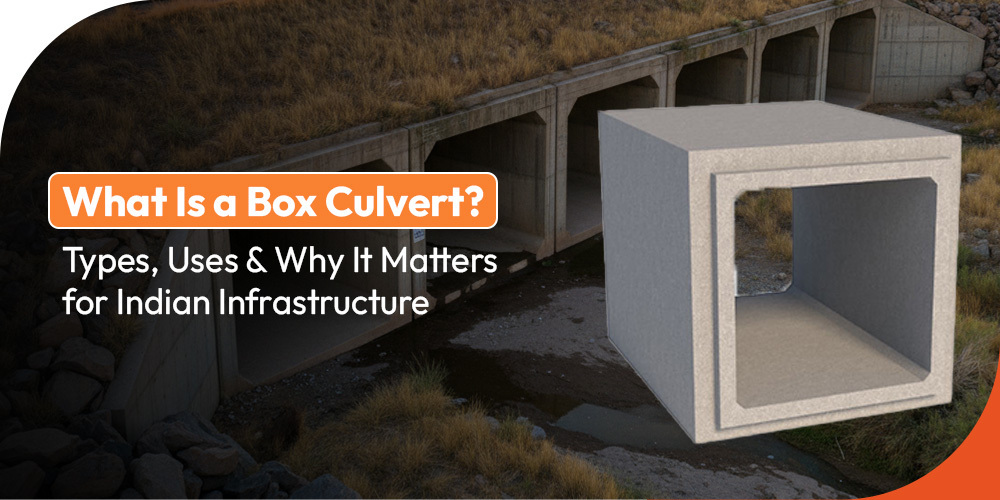
When you look at the pace at which India is building roads, rail networks, industrial corridors, and urban townships, one thing becomes clear: the country needs infrastructure components that are strong, scalable, and dependable. Box culverts fit that category perfectly.
Across highways, railways, drainage systems, and utility corridors, precast box culverts have emerged as one of the most efficient structural solutions, offering strength, speed, and value in one package.
This blog distills what a box culvert is, the different types available, where they are used, and why they’re becoming a priority in India’s long-term development strategy.
1. What Exactly Is a Box Culvert?
A box culvert is a rectangular or square, four-sided reinforced concrete structure designed to allow controlled movement beneath a roadway, railway line, embankment, or industrial corridor.
It serves as a dedicated passageway for:
- Water (stormwater, streams, surface runoff)
- Pedestrians
- Cattle and wildlife
- Vehicles in low-clearance underpasses
- Utility lines (electrical, telecom, pipelines)
- Industrial cable ducts and township service corridors
In practical terms, a box culvert acts as a short-span, load-bearing tunnel capable of safely carrying heavy traffic loads while ensuring uninterrupted flow underneath.
2. Why Precast Box Culverts Stand Out Today
Modern infrastructure demands speed without compromising quality. That’s where precast construction brings real strategic value.
Key Advantages of Precast Box Culverts
- Fast installation: Units are cast off-site and brought ready for placement, reducing site disruption and construction timelines.
- Superior quality: Manufactured in controlled conditions using self-compacted concrete and engineered reinforcement.
- Design flexibility: Available in single-cell and multi-cell formats suitable for varying flow or movement requirements.
- Strength and reliability: Designed for heavy road traffic and rail loadings.
- Modular expansion: Segmental jointed systems make phased or future expansion easier.
- Compliance and safety: Produced as per IS 458, IRC/SP, and ASTM standards.
These attributes make precast box culverts ideal for India’s high-pressure infrastructure execution environment, where reliability, speed, and long-term performance are non-negotiable.
3. Technical Specifications (Industry-Standard Range)
A well-informed project decision starts with understanding the available dimensions and loading parameters. Typical specifications include:
Dimensions
- Internal Width: 600 mm to 3000 mm
- Internal Height: 900 mm to 3000 mm
- Wall Thickness: 50 mm to 100 mm
- Standard Length: 1000 mm sections
This size range offers flexibility across drainage, pedestrian, utility, and underpass applications.
Loading & Engineering Class
Box culverts are engineered for:
- Class A
- Class AA
- IRC loading requirements
- Railway loading
These classifications ensure safe movement of vehicles, heavy industrial transport, and railway rolling stock over the structure.
Design & Construction Formats
- Precast (preferred for speed and consistency)
- Cast-in-situ (used when site conditions demand custom shaping)
Aesthetic Extensions
For bridges, townships, and urban areas:
- Spandrel panels
- Wing walls
- Architectural finishes
These help meet both structural and visual requirements.
4. Types of Box Culverts
Depending on project needs, culverts can vary in design and function:
1. Single-Cell Box Culvert
- One rectangular opening
- Used for moderate water discharge, utility lines, and small crossings
2. Multi-Cell Box Culvert
- Two or more parallel cells
- Used for high-volume flows, larger underpasses, or broad utility corridors
3. Precast Box Culvert
- Standardized units
- Preferred for fast-track projects, controlled quality, and predictable performance
4. Cast-in-Situ Box Culvert
- Custom-built on the site
- Suited for irregular layouts or inaccessible locations
5. Where Box Culverts Are Used in India
India’s terrain, monsoon patterns, and infrastructure density make box culverts indispensable across several sectors. Key applications include:
Transportation Infrastructure
- Road underpasses for vehicles
- Railway underpasses for service access or pedestrian movement
- Bridges & overpasses (especially for short spans)
Public Safety & Rural Access
- Pedestrian crossings
- Cattle crossings
- Village mobility corridors
Water Management
- Stormwater channels
- Seasonal stream crossings
- Drainage solutions beneath roads & railways
Utilities & Industrial Corridors
- Electrical ducting
- Telecom cable tunnels
- Pipeline corridors
- Service tunnels beneath industrial plants
Urban Infrastructure
- Township utility corridors
- Subways and service passages
- Drainage systems for smart-city zones
6. Why Box Culverts Matter for India’s Future
A few trends make box culverts especially critical for India’s infrastructure vision:
1. Rapid Urbanization
Cities need dependable underground systems for utilities, water management, and pedestrian movement. Box culverts provide scalable solutions without disrupting surface infrastructure.
2. Monsoon Resilience
India’s heavy rainfall demands robust stormwater management. The wide cross-section of box culverts improves discharge capacity and reduces flooding.
3. High Traffic Loads
With growing vehicle density and expanded railway networks, structures must handle significant loads. Box culverts are engineered to meet these conditions reliably.
4. Need for Faster Project Delivery
Whether it’s National Highways, DFCC corridors, or industrial zones, precast culverts help expedite execution without compromising safety.
5. Long-Term Durability
The rigid, monolithic frame and controlled-manufacturing process keep lifecycle costs lower, supporting sustainable development goals.
7. Practical Considerations for Engineers and Contractors
Professionals typically evaluate the following while planning or installing box culverts:
- Hydraulic capacity for peak seasonal flows
- Soil bearing capacity and foundation requirements
- Live and dead load calculations as per IRC and railway guidelines
- Joint design for precast modular units
- Maintenance access to prevent silt accumulation
- Future expansion possibilities (especially in multi-utility corridors)
These checkpoints ensure that the installation aligns with long-term structural and functional expectations.
Conclusion
Box culverts may look simple on the surface, but they play a pivotal role in keeping India’s roads, railways, industries, and urban systems running smoothly. Their ability to combine structural capacity, speed of deployment, and adaptability makes them a preferred choice across large-scale infrastructure projects.
As India pushes toward faster, more resilient, and more interconnected development, precast box culverts will continue to be a cornerstone of practical, future-ready engineering.