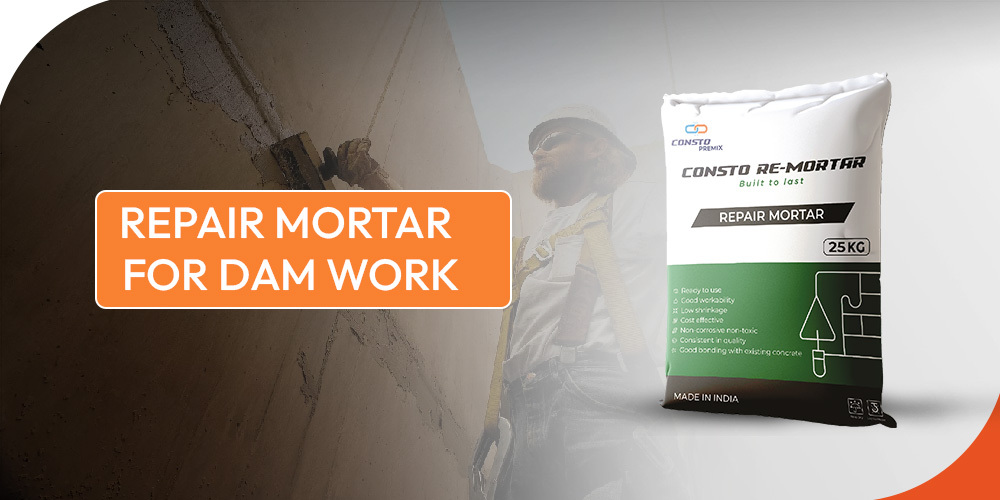
Dams are long-life infrastructure assets. Many concrete dams in service today were constructed decades ago, often under design standards and material practices that differ from current expectations. Over time, exposure to water flow, environmental conditions, and operational stresses leads to surface deterioration. In such cases, repair mortar is commonly used as a controlled and localized repair solution to restore damaged concrete surfaces in old dams.
This article explains how repair mortar is used in old dam rehabilitation, where it is applicable, why it is selected, how it is applied, and the risks that must be managed during the process.
Understanding Deterioration in Old Concrete Dams
Concrete dams are continuously exposed to flowing water, pressure variation, temperature changes, and chemical agents present in water and the surrounding environment. Over long periods, this exposure can result in:
- Surface erosion and wear in spillways and aprons
- Scaling and loss of concrete cover
- Cavitation damage in high-velocity flow areas
- Carbonation and chemical attack
- Local honeycombing or construction defects are becoming visible
These issues typically affect the surface and near-surface zones of concrete elements. While they may not immediately compromise overall structural stability, if left untreated, they can accelerate deterioration and increase maintenance requirements.
What Repair Mortar Means in Dam Rehabilitation
In dam repair work, repair mortar refers to a specially formulated material designed to restore deteriorated concrete surfaces and protect them against further damage. Unlike conventional site-mixed mortar, repair mortar is engineered to achieve predictable strength, controlled shrinkage, and reliable bonding with existing concrete.
The primary purpose of repair mortar in dams is to reinstate surface integrity, restore lost section, and provide a durable interface capable of withstanding exposure to water and environmental conditions.
Where Repair Mortar Is Used in Old Dams
Repair mortar is typically applied in areas where damage is limited to shallow or moderate depths and where the original structural system remains sound. Common locations include:
- Spillway surfaces affected by erosion or cavitation
- Stilling basins and energy dissipation zones
- Downstream faces exposed to splashing and spray
- Aprons and toe slabs with surface wear
- Localized damaged patches on upstream faces during dry periods
These applications are generally non-structural in nature. Repair mortar is used to restore the surface condition rather than to modify the load-carrying capacity of the dam.
Why Repair Mortar Is Selected for Dam Repairs
Repair mortar is chosen for old dam repairs because it allows targeted intervention without large-scale demolition or shutdown of operations. When selected and applied correctly, it provides the following benefits:
- Restores the original concrete profile and flow geometry
- Reduces further erosion and surface degradation
- Improves resistance to water ingress and chemical exposure
- Extends the service life of repaired zones
- Allows repairs to be completed within limited maintenance windows
Its use supports preventive maintenance strategies aimed at preserving existing assets rather than replacing them.
Types of Repair Mortar Used in Dam Applications
The selection of repair mortar depends on site conditions and repair requirements. For dam work, commonly used repair mortars include:
- Cement-based repair mortars for general surface repairs
- Polymer-modified repair mortars where improved bonding and reduced permeability are required
- Fibre-modified repair mortars for areas subject to surface stress or minor movement
The final selection must consider factors such as exposure to flowing water, repair thickness, environmental chemistry, and compatibility with existing concrete.
Surface Preparation: The Foundation of Successful Repair
Surface preparation is the most critical stage in dam repair using repair mortar. Poor preparation is a leading cause of premature repair failure.
The process typically involves removing all loose, deteriorated, or weakened concrete until sound material is exposed. The surface must then be roughened to provide a mechanical key for bonding. Dust, laitance, algae, and contaminants must be completely removed.
Before application, the prepared surface is conditioned to a saturated surface dry state. This prevents excessive moisture loss from the repair mortar and supports proper bonding.
Application of Repair Mortar in Dam Works
Once surface preparation is complete, the repair mortar is mixed strictly as per the manufacturer’s guidelines. Consistency control is essential to avoid segregation or loss of performance.
The mortar is applied manually or using appropriate placement methods depending on the repair area and thickness. For thicker repairs, application is carried out in layers within specified limits to control shrinkage and ensure full compaction.
Care is taken to properly finish the surface to match the surrounding concrete profile, particularly in hydraulic zones where flow behavior is important.
Curing and Post-Repair Protection
Curing is a necessary step to achieve the intended performance of repair mortar. In dam environments, curing methods must be selected to suit site conditions and water exposure.
Proper curing helps control shrinkage, supports strength development, and improves durability. Repairs are protected from rapid drying, temperature extremes, and early water impact until sufficient strength is achieved.
Risks and Limitations of Repair Mortar in Dam Repairs
While repair mortar is effective for surface rehabilitation, it has clear limitations. Risks arise when it is used outside its intended scope or applied incorrectly.
Common risks include debonding due to poor surface preparation, cracking caused by shrinkage or thermal movement, and erosion of repairs in high-velocity flow zones if unsuitable material is used.
Repair mortar should not be used to address structural instability, foundation movement, active leakage under pressure, or deep cracking related to load transfer. Such conditions require structural rehabilitation methods beyond surface repair.
Quality Control and Safety Considerations
Dam repair work demands strict quality control and safety planning. Repairs should be executed under proper supervision, with trial applications where required. Material performance, workmanship, and curing practices must be verified before the repaired area is returned to service.
Safety considerations include working near water bodies, confined spaces, and slippery surfaces. Proper access planning, equipment, and protective measures are essential.
Role of Sneh Repair Mortar in Dam Repair Applications
For surface repair works in old concrete dams, Consto Repair Mortar offers a ready-to-use solution designed for concrete repair applications where controlled strength, bonding, and durability are required.
When selected based on project requirements and applied following proper preparation and curing practices, Sneh Repair Mortar can support maintenance and rehabilitation efforts aimed at extending the service life of existing dam structures.
More information on product specifications and application guidance is available here:
https://snehprecast.com/consto-re-mortar-repair-mortar