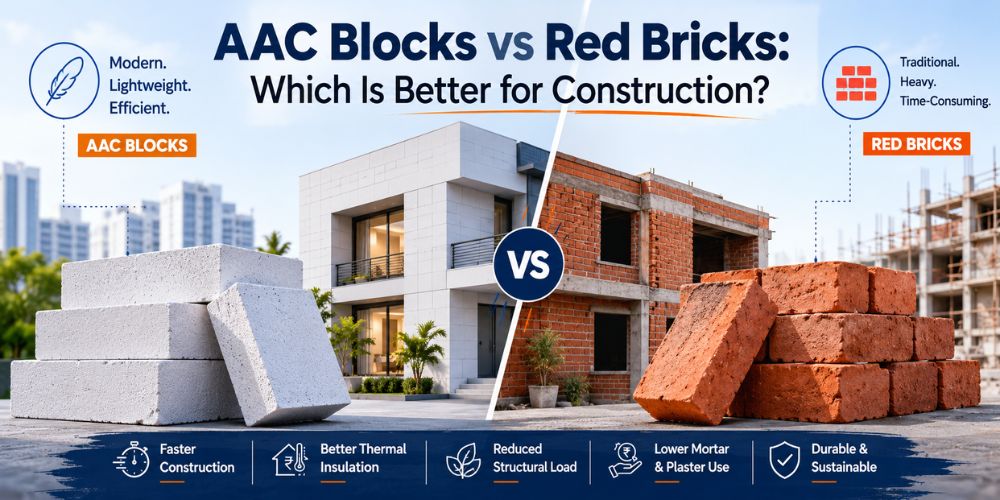
AAC Blocks vs Red Bricks: Which Is Better for Construction?
Choosing the right walling material is one of the most important decisions in any construction project. Whether you are building a home, commercial complex, industrial facility, or institutional building, the material you select affects the structure's strength, construction speed, energy efficiency, maintenance requirements, and overall project cost.
For decades, red bricks have been the preferred choice in Indian construction due to their availability and familiarity among builders. However, with the growing demand for faster construction, energy-efficient buildings, and sustainable practices, Autoclaved Aerated Concrete (AAC) blocks have emerged as a modern alternative.
So, AAC blocks vs red bricks, which is the better choice for construction?
The answer depends on your project's requirements. While both materials have their advantages, AAC blocks are increasingly preferred for modern RCC-framed structures because of their lightweight nature, thermal insulation, and faster installation. Red bricks, on the other hand, continue to be used in traditional masonry and certain load-bearing applications.
In this guide, we'll compare AAC blocks and red bricks across key parameters such as strength, weight, construction speed, insulation, cost, durability, and suitable applications to help you make an informed decision.
What Are AAC Blocks?
Autoclaved Aerated Concrete (AAC) blocks are lightweight precast building materials manufactured using cement, lime, fly ash or sand, water, and a small quantity of aluminium powder. During production, the aluminium reacts with the raw materials to create millions of tiny air pockets, giving AAC blocks their lightweight structure and excellent insulation properties. The blocks are then cured under high-pressure steam in an autoclave, resulting in a strong and dimensionally accurate product.
Unlike conventional masonry units, AAC blocks are larger in size while weighing significantly less. This combination allows faster wall construction with fewer joints and reduced mortar consumption.
Key Features of AAC Blocks
- Lightweight and easy to handle
- High dimensional accuracy
- Excellent thermal insulation
- Good sound insulation
- High fire resistance
- Faster installation due to larger block size
- Lower consumption of mortar and plaster
- Suitable for residential, commercial, industrial, and institutional buildings
Today, AAC blocks are widely used in apartments, office buildings, hospitals, schools, hotels, warehouses, and other RCC-framed structures where speed, efficiency, and long-term performance are priorities.
What Are Red Bricks?
Red bricks, also known as burnt clay bricks, are among the oldest and most widely used construction materials. They are manufactured by moulding natural clay, drying it, and firing it in kilns at high temperatures to achieve the required strength and durability.
Because of their long history in construction, red bricks remain a familiar choice for contractors and masons across India. They are commonly used in residential buildings, compound walls, renovations, and traditional masonry projects.
Key Features of Red Bricks
- Good compressive strength
- Durable when manufactured to quality standards
- Easily available in many regions
- Suitable for traditional masonry construction
- Familiar installation methods for most masons
However, compared to AAC blocks, red bricks are heavier, require more mortar and plaster, and generally take longer to install.
AAC Blocks vs Red Bricks: Quick Comparison
|
|
|
|
|
|
|
|
|
|
|
|
|
|
|
|
|
|
|
|
|
|
|
|
|
|
|
|
|
|
|
|
|
|
|
|
|
|
|
|
|
|
|
|
|
|
|
|
|
|
|
|
|
|
|
|
|
|
|
|
|
|
|
|
AAC Blocks vs Red Bricks: A Detailed Comparison
1. Weight and Structural Load
One of the biggest differences between AAC blocks and red bricks is their weight.
AAC blocks are significantly lighter than traditional clay bricks due to their cellular structure. This reduces the overall dead load on the building, which can lower the load transferred to beams, columns, and foundations. In multi-storey and RCC-framed buildings, a lighter walling material can contribute to more efficient structural design and improved seismic performance.
Red bricks are much heavier, increasing the overall weight of the structure. While this may not be a concern for every project, it can influence foundation design and structural requirements, particularly in larger developments.
2. Construction Speed
Project timelines play an important role in construction costs.
AAC blocks are larger than conventional bricks, allowing more wall area to be completed with fewer units. The reduced number of joints also means less adhesive or mortar is required during installation. As a result, masonry work progresses faster, helping contractors meet project deadlines more efficiently.
Red bricks are smaller, requiring more individual units and additional mortar joints, which generally increases installation time.
3. Compressive Strength
Both AAC blocks and red bricks provide adequate strength when selected and installed according to the project's structural requirements.
Red bricks are traditionally known for their compressive strength and continue to perform well in many masonry applications.
AAC blocks also offer sufficient compressive strength for non-load-bearing walls in RCC-framed buildings, which represent the majority of modern residential and commercial construction. The suitability of either material should always be considered as part of the overall structural design.
4. Thermal Insulation
Buildings exposed to high temperatures benefit from walling materials that reduce heat transfer.
The millions of microscopic air pockets within AAC blocks act as natural insulation, helping to minimise heat flow through walls. This can contribute to improved indoor comfort and may reduce reliance on air conditioning, particularly in warm regions such as Maharashtra.
Red bricks provide some thermal resistance but generally transfer more heat than AAC blocks.
5. Sound Insulation
Noise control is becoming increasingly important in apartments, offices, hospitals, schools, and commercial buildings.
AAC blocks offer better sound insulation due to their porous structure, helping reduce the transmission of external noise between spaces.
Red bricks also provide sound insulation, but their performance is generally lower than AAC blocks of comparable wall thickness.
6. Fire Resistance
Fire safety is an essential consideration for modern buildings.
AAC blocks are non-combustible and provide excellent fire resistance, making them suitable for residential, commercial, and industrial applications where enhanced fire performance is required.
Red bricks are also fire-resistant and have been used successfully for many years. However, AAC blocks generally offer superior fire resistance due to their composition and manufacturing process.
7. Mortar and Plaster Consumption
AAC blocks are manufactured with high dimensional accuracy, allowing them to be installed using thin-bed AAC block adhesive. Their smooth and uniform surfaces also help reduce plaster thickness in many applications.
Red bricks usually require thicker mortar joints to compensate for dimensional variations. They may also require more plaster to achieve a level surface.
Lower consumption of mortar and plaster can contribute to material savings and improved construction efficiency.
8. Ease of Electrical and Plumbing Installation
Electrical conduits and plumbing lines often require wall chasing during construction.
AAC blocks can be cut and chased more easily using appropriate tools, simplifying service installation while reducing labour effort.
Red bricks generally require more time and labour to create service channels.
9. Environmental Impact
Sustainable construction has become an important consideration across the building industry.
AAC blocks make efficient use of raw materials and can incorporate industrial by-products such as fly ash, depending on the manufacturing process. Their lightweight nature also reduces transportation loads and supports resource-efficient construction.
Red bricks require natural clay extraction and kiln firing, processes that consume natural resources and energy.
10. Cost Comparison
Many buyers compare only the purchase price of AAC blocks and red bricks. However, evaluating walling materials based solely on unit cost can be misleading.
While AAC blocks may have a higher initial material cost in some markets, they can help reduce overall construction expenses through:
- Faster installation
- Lower mortar consumption
- Reduced plaster requirements
- Lower structural dead load
- Improved labour productivity
Red bricks may have a lower purchase price, but higher labour, mortar, and finishing requirements can influence the total construction cost.
Instead of comparing only material rates, it is advisable to assess the complete cost of wall construction and long-term building performance.
Better Choice: Depends on the project's overall cost analysis, though AAC blocks often provide better value for modern RCC-framed buildings