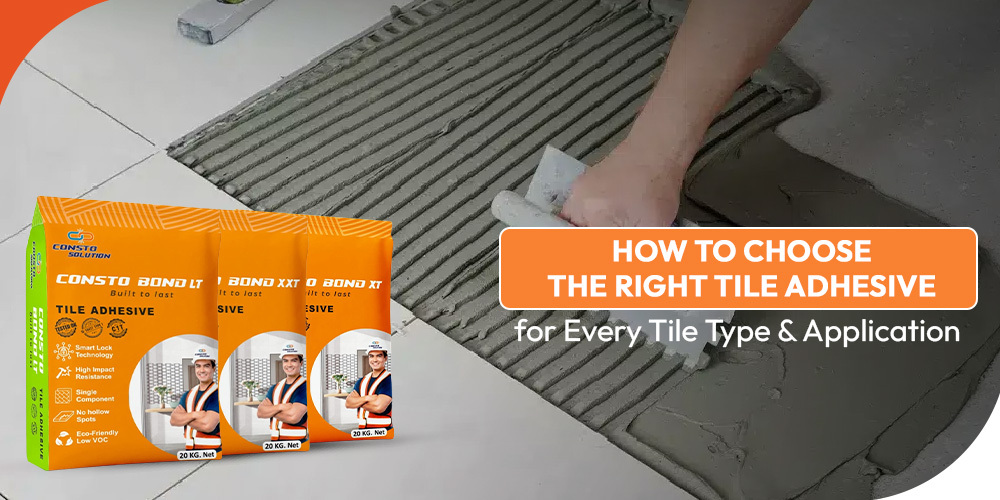
How to Choose the Right Tile Adhesive for Every Tile Type and Application
Tile failures rarely happen because of bad tiles. In real project audits, the root cause is usually simpler, the wrong adhesive, used in the wrong place, under the wrong conditions. The adhesive layer is the working engine of any tile installation. Get that decision right, and the finish lasts for decades. Get it wrong, and even premium tiles won’t save the job.
This guide gives you a practical, field-tested framework to select the correct tile adhesive based on tile behavior, site conditions, and performance class, not guesswork or brand marketing.
Why Adhesive Selection Decides Tile Lifespan
Modern tiles, especially porcelain, vitrified, and large-format slabs, have very low porosity and high density. That means traditional cement mortar bonding is no longer reliable. Today’s installations depend on engineered adhesive systems that deliver:
- Controlled bond strength
- Slip resistance on walls
- Flexibility under movement
- Moisture tolerance
- Thermal stress absorption
Adhesive is not a filler layer. It is a structural bond system.
Tile Adhesive Is a Performance Layer, Not Just Bonding Material
Think of tile adhesive as a load-transfer membrane between the substrate and the tile. Its job includes:
- Transferring live and dead loads
- Absorbing micro-movements
- Handling thermal expansion differences
- Maintaining grip under vibration and traffic
- Resisting moisture intrusion
Thin-bed adhesive systems also reduce shrinkage risk compared to thick mortar beds, provided the correct grade is selected.
Start With Tile Properties; Not Adhesive Brands
Adhesive choice should begin with tile behavior, not product names. Different tiles demand different bonding performance.
Key tile factors that drive adhesive selection:
Porosity
- Ceramic = moderate absorption → standard grades often sufficient
- Porcelain/vitrified = very low absorption → needs high-bond polymer-modified adhesive
Tile size & weight
- Larger tiles create higher shear stress → need improved bond + deformability
Back surface texture
- Smooth backs require higher grab adhesives
Moisture sensitivity
- Marble, limestone, and some stones can stain → need controlled-moisture or reaction-grade systems
Format
- Large-format slabs require high-performance, deformable adhesive grades and stricter coverage rules
Site Conditions That Change Adhesive Grade
Even the right adhesive for a tile can fail if site conditions are ignored.
Upgrade adhesive class when you have:
- Exterior exposure
- Wet areas (bathrooms, pools, kitchens)
- Floor installations vs wall décor
- Tile-on-tile renovation
- Terrace or balcony work
- Underfloor heating systems
- High foot traffic zones
Environmental risk = adhesive performance upgrade. No shortcuts here.
Adhesive Technology Categories Where Each One Wins
Polymer-Modified Cement Adhesives
Best all-round performers for modern work.
Use for:
- Porcelain and vitrified tiles
- Floor installations
- Exterior areas
- Medium to large formats
Strength: Strong bond + versatility
Risk if misused: Basic grades may fail with large tiles
High-Flex / Deformable Adhesives
Built to absorb movement stress.
Use for:
- Large-format tiles
- Heated floors
- Balconies and terraces
- Substrates with slight movement
Strength: Movement tolerance
Trade-off: Higher cost, but cheaper than rework
Rapid-Setting Adhesives
Fast-track project tools.
Use for:
- Time-bound commercial jobs
- Repair zones
- Cold-weather work
Strength: Quick return to service
Risk: Short working time, needs disciplined crews
Reaction-Based Adhesives (Epoxy / PU Class)
Chemical-cure systems.
Use for:
- Pools
- Industrial kitchens
- Chemical exposure zones
- Glass mosaic
- Resin-backed tiles
Strength: Waterproof + chemical resistant
Trade-off: Cost and handling complexity
Ready-Mix Wall Adhesives
Convenience products, but limited scope.
Use for:
- Small ceramic tiles on interior dry walls only
Avoid for:
- Floors
- Wet zones
- Porcelain tiles
- Exterior areas
How to Read an Adhesive Bag Like a Professional
Most decision mistakes happen because buyers ignore the technical label. Train your eye to scan these parameters:
- Bond class → improved vs standard
- Slip resistance → critical for walls
- Open time → working window after spreading
- Pot life → usable time after mixing
- Deformability rating → movement tolerance
- Coverage per bag → cost realism
- Bed thickness limit → tile size compatibility
- Approved substrates → compliance check
If the bag doesn’t clearly state performance class and test values, treat it as a red flag.
Tile-to-Adhesive Selection Matrix (Quick Reference)

Installation Variables That Directly Impact Adhesive Performance
Even the best adhesive fails under poor execution.
Control these variables:
Trowel notch size
- Larger tiles → larger notch → higher coverage
Coverage target
- Floors & exterior → near full coverage
- Spot bonding is unacceptable
Back buttering
- Mandatory for large-format tiles
Mixing ratio
- Overwatering reduces bond strength
Working time discipline
- Don’t place tile after skin formation
Temperature
- Heat shortens open time
- Cold slows curing
Execution discipline protects adhesive performance.
High-Risk Selection Errors That Cause Debonding
Watch for these repeat offenders on failed sites:
- Using wall-grade adhesive on floors
- Using basic adhesive for porcelain tiles
- Ignoring tile size limits per product
- Applying over dusty or weak substrates
- Adding extra water to “improve workability.”
- No movement joints in large areas
- Using ready-mix adhesive in wet zones
Each one looks small. Each one is expensive later.
Rapid Decision Checklist
If your situation is → choose this adhesive class:
- Porcelain floor tile → Improved polymer-modified grade
- Large-format slab → High-bond deformable adhesive
- Bathroom / wet zone → Water-resistant high-performance grade
- Swimming pool → Reaction-based system
- Tile over tile → High-grab improved adhesive
- Heated floor → Flexible/deformable grade
- Interior ceramic wall → Standard polymer-modified adhesive