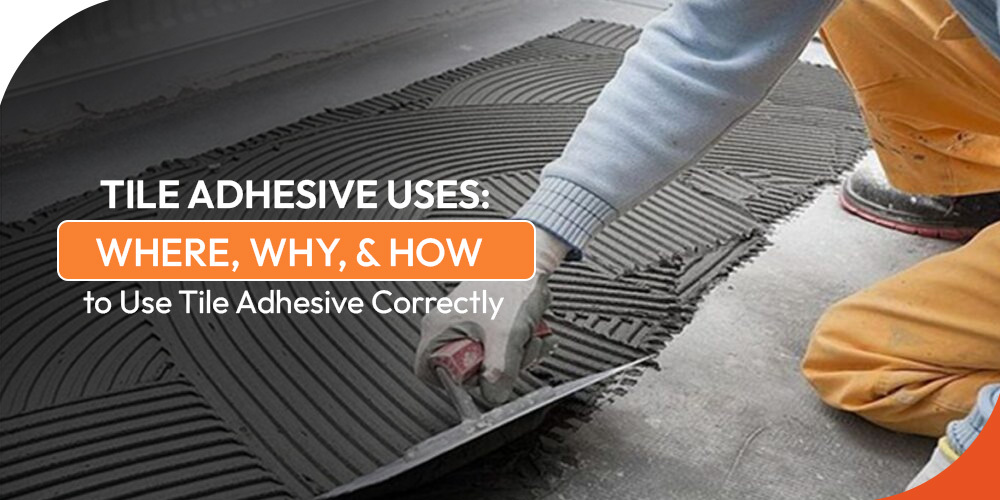
Tile installation today depends less on traditional methods and more on controlled bonding systems. Tile adhesive plays a central role in ensuring tiles remain fixed, aligned, and functional over time. Understanding where tile adhesive should be used, why it is required, and how it must be applied correctly helps avoid failures such as tile debonding, hollow sound, or surface damage.
This guide explains tile adhesive use from a practical installation perspective.
What Is Tile Adhesive
Tile adhesive is a prepared bonding material used to fix tiles to different surfaces. Unlike site-mixed cement mortar, tile adhesive is formulated to provide controlled grip, workability, and setting behavior.
It is supplied in ready-to-use or powder form and is mixed with water before application. Tile adhesive is designed to support uniform bonding between the tile and the substrate.
Where Tile Adhesive Is Used
Tile adhesive is not limited to one type of location. Its use depends on the surface, the tile, and the exposure conditions. Below are the common and correct application areas.
1. On Cement-Plastered Walls
Tile adhesive is used on cement-plastered walls for fixing wall tiles in residential and commercial spaces.
Why is it used here
- Provides holding support against gravity
- Helps maintain tile alignment
- Reduces tile slippage during installation
Typical applications
- Bathrooms
- Kitchens
- Utility areas
- Interior walls
Before application, the wall surface must be clean, cured, and free from loose material.
2. On Concrete and Screed Floors
Tile adhesive is used on concrete floors and screed bases where floor tiles are installed.
Why it is used here
- Supports uniform load distribution
- Helps prevent tile movement
- Improves contact between tile and base
Typical applications
- Living areas
- Commercial floors
- Corridors
The base should be level and free from oil, dust, or curing compounds.
3. In Bathrooms and Wet Areas
Bathrooms and wash areas require controlled bonding due to frequent water exposure.
Why is tile adhesive required
- Maintains tile grip under moisture conditions
- Reduces water penetration behind tiles
- Supports consistent tile placement
Tile adhesive should be applied only after the waterproofing layers are completed and cured
4. In Kitchens
Kitchens experience regular cleaning, temperature variation, and usage.
Why is this adhesive suitable
- Maintains tile stability during cleaning cycles
- Supports wall and floor tile fixing
- Helps avoid tile loosening over time
It is commonly used for:
- Kitchen walls
- Counter backsplashes
- Floor tiles
5. For Large-Format Tiles
Large tiles require even bonding coverage to avoid hollow areas.
Why is tile adhesive used
- Provides full-surface contact
- Helps distribute tile weight
- Reduces breakage risk
In such cases, correct adhesive thickness and trowel selection become critical.
6. For Tile-on-Tile Application
Tile adhesive is used when new tiles are installed over existing tiles.
Why tile adhesive works here
- Bonds to non-absorbent surfaces
- Eliminates the removal of old tiles
- Reduces construction time
The existing tile surface must be cleaned and roughened before application.
7. On Precast and Cement-Based Elements
Tile adhesive is suitable for precast surfaces once they are stable and cured.
Why tile adhesive is used
- Supports bonding on dense surfaces
- Provides controlled adhesion
Surface preparation remains essential.
Why Tile Adhesive Is Used Instead of Cement Mortar
Traditional cement mortar relies on site mixing and variable ratios. Tile adhesive offers consistency and application control.
Key reasons for using tile adhesive
- Predictable bonding behavior
- Reduced application thickness
- Controlled setting time
- Reduced tile adjustment issues
Tile adhesive supports modern tile sizes and installation requirements more reliably.
How to Use Tile Adhesive Correctly
Correct application is as important as choosing the right material. Each step must follow site practice standards.
Step 1: Surface Preparation
Surface preparation determines bonding outcome.
Ensure the surface is
- Clean and free from dust
- Free from oil, paint, or loose particles
- Cured and stable
Wet the surface lightly if required, but avoid standing water.
Step 2: Mixing Tile Adhesive
Tile adhesive must be mixed as per the recommended water ratio.
Mixing process
- Add water to a clean container
- Slowly add adhesive powder
- Mix until uniform consistency is achieved
- Allow resting time if specified
- Remix before application
Avoid adding excess water.
Step 3: Applying Tile Adhesive
Apply adhesive using a notched trowel.
Application method
- Spread adhesive evenly on the surface
- Hold the trowel at a consistent angle
- Maintain uniform thickness
Apply adhesive only over an area that can be tiled within the open time.
Step 4: Fixing the Tiles
Place tiles while the adhesive is workable.
Tile placement steps
- Press the tile firmly into the adhesive
- Adjust alignment immediately
- Use spacers if required
Avoid disturbing tiles after placement.
Step 5: Setting Time and Grouting
Allow adhesive to set before grouting.
General guidance
- Avoid walking on floor tiles during the initial set
- Begin grouting only after the adhesive has set
- Follow the recommended waiting time
Do not apply water during the setting phase unless specified.
Common Mistakes to Avoid
- Applying adhesive on dusty surfaces
- Using excess water while mixing
- Applying adhesive over large areas at once
- Fixing tiles after adhesive skin formation
- Skipping surface checks
Most failures are related to process errors, not material issues.
Choosing Tile Adhesive for the Right Application
Tile adhesive selection depends on:
- Tile size
- Surface type
- Location
- Exposure conditions
Always match adhesive type to site requirements rather than using one solution everywhere.
Consto Bond Tile Adhesive
For applications where consistent bonding and controlled installation are required, Consto Bond Tile Adhesive is designed to support tile fixing across common construction conditions.
Consto Bond is available in variants suitable for:
- Wall tile installation
- Floor tile installation
- Small, medium, and large-format tiles
- Interior areas under normal usage conditions
The product range supports standard site practices, allowing installers to maintain uniform adhesive thickness and stable tile placement when applied as per recommended methods.
Conclusion
Tile adhesive is a controlled bonding solution designed to support modern tile installation needs. Its correct use depends on understanding application areas, surface conditions, and installation steps. When used properly, tile adhesive helps ensure stable tile placement and reduced maintenance issues over time