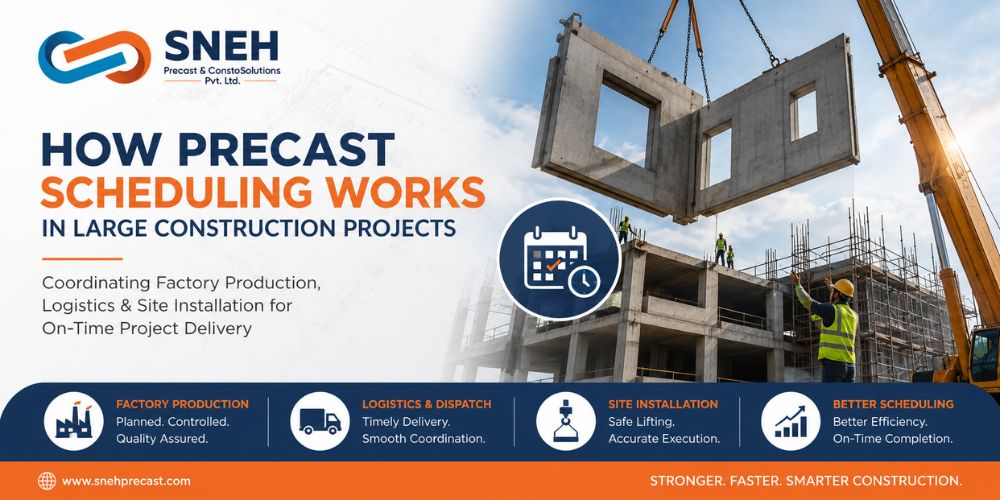
How Precast Scheduling Works in Large Construction Projects
Key Takeaways:
-
Precast scheduling connects manufacturing, transportation, and installation within a single execution workflow.
- Delays in one stage quickly affect production continuity and site execution activities.
- Weather conditions, transportation issues, material inconsistencies, and approval delays are among the biggest causes of project disruption.
- Large precast projects depend heavily on crane planning, dispatch coordination, and installation sequencing.
- Factory-to-site synchronization is one of the most important parts of precast construction planning..
Large construction projects involve continuous coordination between production teams, transportation vendors, site engineers, crane operators, and installation crews. When one activity gets delayed, the impact often spreads across the project timeline. In many cases, delays do not happen because of a single issue. They usually develop when multiple activities lose coordination at the same time.
This is why project scheduling plays an important role in modern construction. Scheduling is not only used to track timelines or monitor deadlines. In large projects, it helps teams coordinate manpower, equipment movement, procurement activities, transportation planning, and installation sequences throughout the execution process.
In precast construction, scheduling becomes even more important because work is divided between factory production and site installation. Structural components are manufactured inside controlled production facilities, transported according to dispatch schedules, and installed on-site in planned sequences. Every stage depends on proper coordination between manufacturing, logistics, and execution teams.
Across India, infrastructure and industrial projects are increasingly adopting precast construction because of faster execution timelines and controlled production quality. However, maintaining speed in precast projects depends heavily on synchronized planning. If production slows down, transportation schedules shift. If dispatch activities get delayed, installation continuity on-site also gets affected. This interconnected workflow is what makes precast scheduling different from conventional construction planning.
What Is Project Scheduling in Construction?
Project scheduling in construction is the process of organizing activities in a planned sequence to maintain workflow continuity throughout project execution. It helps construction teams coordinate labor movement, procurement schedules, equipment allocation, transportation planning, and installation activities within defined timelines.
In large projects, hundreds of activities often happen simultaneously across different departments. Structural work, production planning, transportation movement, electrical coordination, procurement activities, and site execution frequently overlap within limited deadlines. Without proper scheduling, delays in one activity can immediately affect multiple dependent operations.
This becomes even more challenging in Indian construction projects where execution teams regularly deal with monsoon disruptions, traffic congestion, labor shortages, approval delays, and multi-vendor coordination issues. In many infrastructure projects, transportation movement itself becomes a scheduling challenge because large precast components require route planning, unloading coordination, and movement permissions before dispatch activities begin.
In precast construction, scheduling controls much more than timelines. It directly affects factory productivity, logistics continuity, installation sequencing, and equipment utilization. Manufacturing facilities must align production cycles according to erection priorities on-site. If installation teams are preparing to complete a particular zone, the factory adjusts production and dispatch schedules according to that requirement.
This is why precast scheduling functions as an operational coordination system rather than a simple planning document.
Types of Schedules Used in Construction Projects
Large construction projects use different scheduling methods to control long-term planning and short-term execution activities. These schedules help project teams maintain coordination across manufacturing facilities, transportation systems, subcontractors, and installation crews.
A master schedule is usually prepared during the initial planning stage of a project. This schedule provides a high-level overview of project milestones, structural completion targets, procurement timelines, and delivery deadlines. Infrastructure and industrial projects often rely on master schedules to monitor whether execution activities are progressing according to planned timelines.
Along with master schedules, project teams also prepare look-ahead schedules to manage short-term activities more effectively. These schedules focus on immediate execution requirements such as labor coordination, material movement, transportation planning, and installation targets for the coming days or weeks. In precast construction, look-ahead scheduling becomes extremely important because dispatch activities must align closely with crane availability and erection sequences on-site.
Large projects also depend on Critical Path Method scheduling, commonly known as CPM scheduling, to identify activities that directly affect project completion timelines. In precast projects, activities such as drawing approvals, mold preparation, production sequencing, dispatch coordination, and crane planning often fall under critical path operations. If one of these activities gets delayed, the impact spreads across multiple execution stages.
Many industrial and commercial projects now use pull planning systems to improve coordination between consultants, manufacturing units, logistics vendors, and installation teams. Instead of planning activities only from the project start date, teams work backward from completion milestones and align workflows according to site priorities. This approach becomes particularly useful in fast-track projects where manufacturing and installation activities happen simultaneously.
How Does Precast Construction Work?
Precast construction involves manufacturing concrete components inside a controlled factory environment before transporting them to the construction site for installation. Unlike conventional construction methods, where structural work happens directly on-site, precast systems depend heavily on planned production and synchronized execution workflows.
The process begins with structural design development and shop drawing preparation. Every precast component must be designed according to project specifications before manufacturing begins. These drawings define dimensions, reinforcement details, lifting points, connection systems, and installation requirements. In large projects, approval delays during this stage often affect the complete production schedule because factories cannot begin mold preparation without finalized drawings.
Once approvals are completed, manufacturing activities begin inside the production facility. Factories prepare molds according to component specifications and organize casting cycles based on installation priorities. Production planning depends on mold availability, curing timelines, dispatch schedules, and site execution requirements. Large precast manufacturers handling multiple infrastructure and industrial projects simultaneously must continuously balance production capacity across different schedules.
After production, components are transferred to storage yards before dispatch. Yard management plays a major role in large precast projects because improper storage sequencing creates rehandling issues, congestion, and dispatch confusion. In many projects, components are stored according to erection sequences so transportation and unloading activities can continue without interruptions.
Transportation planning becomes one of the most sensitive stages of precast scheduling because large components require detailed dispatch coordination. Delivery timing must align with crane availability and installation priorities on-site. In India, transportation schedules are frequently affected by highway restrictions, city traffic movement, monsoon conditions, unloading congestion, and over-dimensional cargo permissions.
In many projects, installation teams often lose productivity because trailers carrying precast elements arrive late at the site. When this happens, crane operations stop temporarily while erection crews wait for the next dispatch. These delays may appear small initially, but over time they affect installation continuity and milestone completion schedules across the project.
Once components arrive on-site, cranes and erection teams begin installation activities according to planned sequences. Site execution depends heavily on accurate delivery timing because precast installation follows strict workflow continuity. If required components are unavailable during erection activities, installation teams cannot proceed with the planned sequence.
How Scheduling Works in Large Precast Projects
Scheduling in large precast projects functions as a coordination system connecting manufacturing facilities, logistics movement, transportation vendors, crane operations, and site installation activities together. Unlike traditional construction planning, precast scheduling must continuously balance factory productivity with site execution priorities.
Production activities inside the factory are usually planned according to erection sequences defined by the project execution team. For example, if installation work is scheduled in a specific project zone, manufacturing teams adjust production priorities according to that sequence. This coordination helps reduce unnecessary storage pressure while maintaining installation continuity on-site.
Production sequencing is another important part of precast scheduling because manufacturing facilities operate with limited mold capacity and fixed curing timelines. Project teams must decide which components should receive production priority, how dispatch schedules should align with installation targets, and how manufacturing output can support multiple projects simultaneously.
In many large projects, production speed alone does not guarantee faster project delivery. Several projects experience delays even after achieving planned manufacturing output because transportation movement and installation activities fail to maintain the same pace. This is one of the biggest operational challenges in precast construction.
Logistics synchronization also plays a major role in project execution. Transportation planning must align with unloading schedules, crane allocation, site access conditions, and erection priorities. If trailers arrive late or unloading areas remain blocked, installation crews lose continuity immediately. In large infrastructure projects, crane idle time becomes one of the biggest hidden operational costs when dispatch schedules and erection activities lose coordination.
Site readiness is equally important in precast construction. Even when production and transportation activities are completed on time, installation cannot proceed if access roads, crane positioning, labor coordination, or safety clearances remain incomplete. This is why continuous communication between factory teams and site engineers becomes essential throughout project execution.
Understanding the Real Causes of Construction Delays
Construction delays usually develop because of coordination gaps between multiple project activities rather than one isolated issue. In precast construction, delays spread faster because manufacturing, transportation, and installation activities are interconnected.
Weather conditions remain one of the biggest causes of disruption in Indian construction projects. Heavy rainfall, flooding, and strong wind conditions directly affect transportation movement and crane operations. During monsoon periods, installation activities slow down significantly because large precast elements require stable lifting conditions during erection work.
Material inconsistencies also affect project continuity. Delayed steel deliveries, missing inserts, incorrect dimensions, and quality issues often interrupt production schedules inside factories. Since precast manufacturing follows planned sequences, even one missing component can disturb transportation and installation workflows across the project.
Approval delays continue to be another major challenge in large construction projects. Design revisions and consultant approvals often take longer than expected, affecting mold preparation, production planning, and dispatch schedules simultaneously. These delays create chain reactions because downstream activities depend entirely on finalized drawings.
Transportation delays frequently affect large infrastructure projects due to traffic restrictions, trailer shortages, unloading congestion, and route limitations. Since installation activities depend on exact delivery timing, transportation disruptions directly affect crane productivity and labor efficiency on-site.
Coordination gaps between consultants, factory teams, logistics vendors, subcontractors, and installation crews also contribute to execution delays. In many projects, communication delays between departments create confusion in dispatch planning and erection sequences, which eventually slows down project continuity.
Why Delays Spread Faster in Precast Construction
Precast construction follows interconnected workflows where every activity depends on the successful completion of the previous stage. This dependency structure is the main reason delays spread faster in precast projects compared to traditional construction methods.
For example, if drawing approvals are delayed, production schedules immediately shift inside the factory. Once manufacturing timelines move, transportation planning also changes because dispatch activities depend on production completion. If dispatch schedules shift, crane allocation and installation sequences on-site also get affected. As a result, labor productivity drops, equipment utilization decreases, and milestone deadlines begin moving across the project timeline.
In many large projects, storage yard congestion becomes another hidden scheduling issue. When installation activities slow down on-site, manufactured components continue arriving inside the storage yard. Over time, this creates congestion, increases rehandling movement, and affects dispatch efficiency. Eventually, production teams must slow manufacturing activities because storage capacity becomes limited.
This is why precast scheduling requires continuous coordination between factory production, transportation movement, and installation execution throughout the project lifecycle.
Role of Scheduling Software in Precast Projects
Modern infrastructure and industrial projects increasingly depend on scheduling software to improve coordination between manufacturing facilities and site execution teams. Large projects commonly use Primavera P6, Microsoft Project, BIM coordination systems, ERP platforms, and production tracking tools to monitor execution continuity.
These systems help project teams track manufacturing schedules, dispatch timelines, transportation movement, installation targets, and delay risks within a centralized planning structure. Digital coordination tools also improve communication between factory operations and site execution activities, helping project teams respond faster to scheduling disruptions.
As precast construction continues expanding across infrastructure and industrial sectors in India, digital planning systems are becoming increasingly important for maintaining workflow visibility, production continuity, and execution efficiency.
Conclusion
Precast scheduling plays a critical role in maintaining execution continuity across large construction projects. Unlike traditional construction methods, precast construction depends on synchronized coordination between manufacturing facilities, transportation systems, crane operations, and site installation activities.
Production sequencing, dispatch planning, logistics movement, and site readiness must remain aligned continuously to maintain project timelines. Even small disruptions in one stage can create delays across the entire workflow because every activity depends on planned execution sequences.
As precast construction continues growing across infrastructure, industrial, and commercial developments in India, detailed scheduling and operational coordination will remain essential for maintaining project delivery timelines, workflow continuity, and execution efficiency.