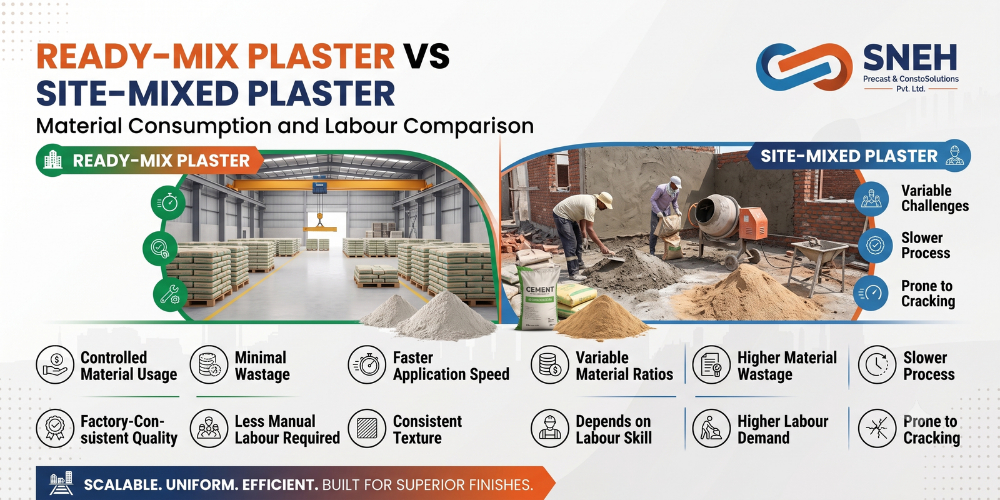
Ready-Mix Plaster vs Site-Mixed Plaster: Material Consumption and Labour Comparison
Plastering plays an important role in construction by providing a smooth and durable finish to walls and ceilings. Traditionally, plaster is prepared on site by mixing cement, sand and water. Ready-mix plaster, also known as premix plaster, is supplied as a pre-blended material that is mixed with water before application.
When comparing ready-mix plaster vs site-mixed plaster, contractors and project owners need to consider more than the initial material price. Material consumption, labour, wastage, preparation time, handling, consistency and overall project requirements can all affect the final plastering cost.
What Is Ready-Mix Plaster?
Ready-mix plaster is a factory-prepared dry mixture containing cementitious materials, graded aggregates and other performance components in controlled proportions. The material is supplied in bags and is generally prepared by adding the recommended amount of water before application.
Compared with conventional plaster, ready-mix plaster reduces the need to separately measure and mix cement and sand at the construction site.
Before using a premix product, contractors should understand the ready-mix plaster application process, including surface preparation, mixing, application thickness and curing requirements.
Sneh Precast's Consto Plast is a premix plaster designed for internal and external wall applications. It can be used on surfaces such as red brick, fly ash brick, AAC blocks, concrete blocks and RCC.
What Is Site-Mixed Plaster?
Site-mixed plaster is prepared directly at the construction site using cement, sand and water. The materials are measured according to the required mix proportion and then mixed before being transported to the application area.
The actual consumption of site-mixed plaster depends on factors such as cement-sand ratio, plaster thickness, sand characteristics, wall unevenness and material wastage.
Because the mixing process is performed at the site, accurate measurement and proper mixing are important for maintaining consistency between batches.
Ready-Mix Plaster vs Site-Mixed Plaster: Key Differences
| Factor | Ready-Mix Plaster | Site-Mixed Plaster |
|---|---|---|
| Material preparation | Pre-blended | Mixed at site |
| Proportioning | Controlled formulation | Depends on site measurement |
| Sand handling | No separate sand handling | Required |
| Mixing | Add water and mix | Cement, sand and water mixed |
| Labour | Fewer preparation activities | More handling and preparation |
| Consistency | Controlled formulation | Depends on site practices |
| Wastage | Can be controlled through planned usage | Depends on handling and mixing |
| Storage | Bagged material | Cement and sand stored separately |
| Quantity planning | Based on product coverage | Based on mix and site conditions |
Material Consumption: Ready-Mix vs Site-Mixed Plaster
Ready mix plaster consumption depends on plaster thickness, substrate condition, application method and the manufacturer's stated coverage.
For example, Consto Plast provides approximately 18–20 sq. ft. coverage per 40 kg bag at 10 mm thickness, depending on the substrate.
You can review the Consto Plast premix plaster product information for product-specific coverage and application details.
For site-mixed plaster, material consumption is calculated based on the required plaster volume and the specified cement-sand mix. Uneven walls can increase the amount of material required because a greater average thickness may be necessary.
Therefore, plaster material consumption should be estimated using actual project conditions rather than relying on a single standard figure.
How to Calculate Plaster Material Requirements
A basic plaster quantity calculation begins with the surface area and plaster thickness.
Plaster volume = Surface area × Plaster thickness
For example, for a 100 m² wall with 10 mm plaster thickness:
100 × 0.010 = 1.0 m³
This gives the basic plaster volume. The actual quantity of ready-mix plaster or site-mixed materials will depend on the product's technical specifications, substrate condition, application method and expected wastage.
For ready-mix plaster, manufacturers generally provide coverage information that can help with bag-level planning. For site-mixed plaster, cement and sand quantities need to be calculated according to the specified mix.
Labour Comparison
Labour is an important consideration when comparing ready mix plaster labour cost with site-mixed plaster.
Site-mixed plaster generally involves several preparation activities:
-
Cement and sand unloading
-
Material measurement
-
Sand handling
-
Mixing
-
Transportation to the work area
-
Plaster application
-
Finishing and cleaning
With ready-mix plaster, the dry material is already blended. The site team generally needs to add the recommended quantity of water, mix the material and apply it according to the specified procedure.
This can simplify material preparation and handling, particularly where large areas require repetitive plastering. However, ready-mix plaster still requires appropriate workmanship for surface preparation, application and finishing.
Material Wastage
Plaster wastage can occur in both systems.
For site-mixed plaster, potential wastage can result from:
-
Excess mortar preparation
-
Sand handling
-
Spillage
-
Incorrect proportioning
-
Material left unused after mixing
For ready-mix plaster, wastage may result from incorrect preparation, over-mixing, spillage or application losses.
The actual wastage level depends on site management, worker practices, surface condition and application technique. Therefore, the plaster type alone does not determine the final wastage percentage.
Productivity and Project Time
The preparation process can influence the overall plastering workflow.
Site-mixed plaster requires separate cement and sand handling followed by measurement and mixing. Ready-mix plaster reduces these preparation steps because the dry components are already proportioned.
For large residential, commercial and infrastructure projects, this simplified workflow can make material planning and repetitive application easier.
Sneh Precast's ready-mix plaster consumption and application guide provides additional information about consumption, application methods, wastage and project considerations.
Total Cost: Material Price Is Only One Factor
When comparing ready-mix plaster with conventional plaster, the lowest material purchase price does not necessarily represent the lowest overall project cost.
The total plastering cost can include:
Material + Labour + Handling + Mixing + Equipment + Wastage + Time
For this reason, contractors should evaluate the complete installed cost.
For example, site-mixed plaster may require separate cement and sand procurement and additional handling, while ready-mix plaster may simplify material preparation and storage. Actual savings or additional costs will depend on local material prices, labour rates, project size and site conditions.
Which Plastering Method Should You Choose?
The appropriate plastering method depends on the project.
For smaller projects where cement and sand are readily available, site-mixed plaster may be practical. For larger projects with repetitive plastering requirements, ready-mix plaster can simplify material handling, proportioning and quantity planning.
Before selecting a system, consider:
-
Total plastering area
-
Required thickness
-
Substrate condition
-
Material availability
-
Labour availability
-
Expected wastage
-
Application method
-
Project schedule
-
Total installed cost
Why Consider Consto Plast Premix Plaster?
Consto Plast is a ready-to-use premix plaster solution for internal and external applications. It can be applied to red brick, fly ash brick, AAC blocks, concrete blocks and RCC surfaces.
Its stated coverage is approximately 18–20 sq. ft. per 40 kg bag at 10 mm thickness, depending on the substrate.
For product-specific information, contractors can review the Consto Plast premix plaster page and evaluate its suitability based on project requirements.
Conclusion
The choice between ready-mix plaster and site-mixed plaster depends on project requirements rather than a single cost factor. Material consumption, labour, wastage, preparation time, consistency, handling and application conditions should all be considered.
For projects where controlled material preparation and simplified site handling are important, a premix solution such as Consto Plast can be evaluated alongside conventional site-mixed plaster based on the project's technical and commercial requirements.