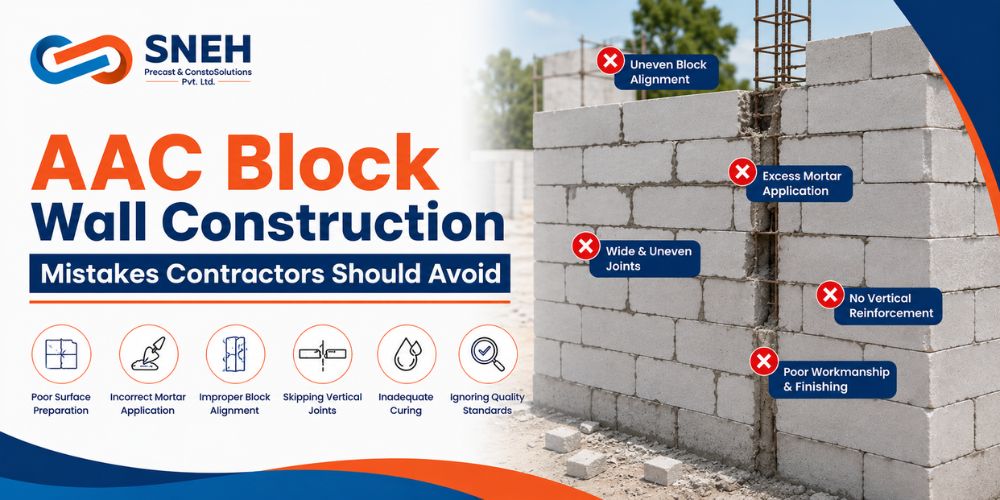
AAC Block Wall Construction Mistakes Contractors Should Avoid
AAC blocks have become the preferred walling material for residential and commercial projects across Maharashtra lighter than red bricks, faster to lay, and better insulated. But AAC masonry isn't just "bricklaying with bigger blocks." It's a different system with its own rules, and when contractors apply brickwork habits to AAC construction, the results show up as cracks, weak joints, and water seepage sometimes months after the wall looks finished.
Here's what commonly goes wrong on site, and how to avoid it.
Why AAC Construction Demands a Different Approach
In traditional brickwork, mortar joints run 10–12 mm thick and can absorb minor surface irregularities. AAC blockwork works differently: the joint is only 2–3 mm thick, using a specially formulated block jointing mortar rather than conventional cement-sand mortar. Because the layer is so thin, there's very little margin for error, mistakes in mixing, surface prep, or application don't announce themselves immediately, but they compromise the wall's strength and finish over time.
Common Mistakes on AAC Sites
- Using thick mortar joints instead of thin-bed application. Applying mortar the way you would for brickwork 10 mm or more is one of the most frequent errors. It defeats the purpose of AAC's precision-cut blocks and creates uneven load distribution across the wall.
- Incorrect water ratio in jointing mortar. Too much or too little water changes how well the mortar bonds the blocks. This is a quiet failure — the wall can look fine at construction and develop weakness only later.
- Skipping surface cleaning before block placement. Dust on the block surface reduces adhesion significantly. Every block face should be free of debris before mortar is applied.
- Poor storage leading to moisture absorption. AAC blocks are porous and absorb moisture easily. Blocks left uncovered or stored directly on wet ground on site — especially through Pune and Nashik's monsoon months — pick up excess water that affects both handling and bond strength.
- Misaligned or uneven first course. The first row of blocks sets the reference line for the entire wall. Any unevenness here compounds as construction proceeds upward, and correcting it later is far harder than getting it right at the base.
- Ignoring movement joints on long walls. Long AAC walls need designed movement joints to manage thermal expansion and minor structural shifts. Skipping these is a common cause of diagonal cracking near openings and column junctions.
- Using standard fixings instead of AAC-specific anchors. AAC's cellular structure doesn't hold conventional fasteners the way dense concrete does. Heavy fixtures need mechanical or chemical anchors rated for AAC, not standard masonry screws.
- Rushing application beyond the mortar's working time. Jointing mortar typically stays workable for only 5–10 minutes once mixed. Placing a block on mortar that's already started to skin over looks fine on the surface but produces a weak bond underneath.
Warning Signs These Mistakes Are Already in the Wall
If any of the above have slipped through, watch for stepped joints appearing under plaster, diagonal cracks forming near columns or window openings, and water seepage or efflorescence patches on external walls after the first monsoon. These are rarely random — they usually trace back to one of the execution issues above.
Getting the Materials Right
Good technique only goes as far as the materials support it. AAC blocks should meet IS 2185 (Part 3) compressive strength requirements, and jointing mortar should be a proper thin-bed formulation designed for AAC — not a generic substitute. When both the blocks and the mortar are engineered to work together, first-course alignment is easier to hold and the joint bond is far more forgiving of small site variables.
If your project mixes wall types — for instance, load-bearing sections in solid concrete blocks or hollow blocks alongside AAC infill walls — the same principle applies: match the mortar to the block. Our full mortar solutions range covers jointing, plastering, and repair products for each.
For a full breakdown of mix ratios, application steps, and standards, see our detailed guide on choosing and applying block jointing mortar.
Getting AAC Masonry Right the First Time
None of these mistakes stem from a flaw in AAC as a material — they're execution issues, and every one of them is preventable with the right process and the right supplier relationship. If your site team is specifying AAC blocks alongside a compatible jointing mortar, you remove most of the guesswork before the first block goes up.