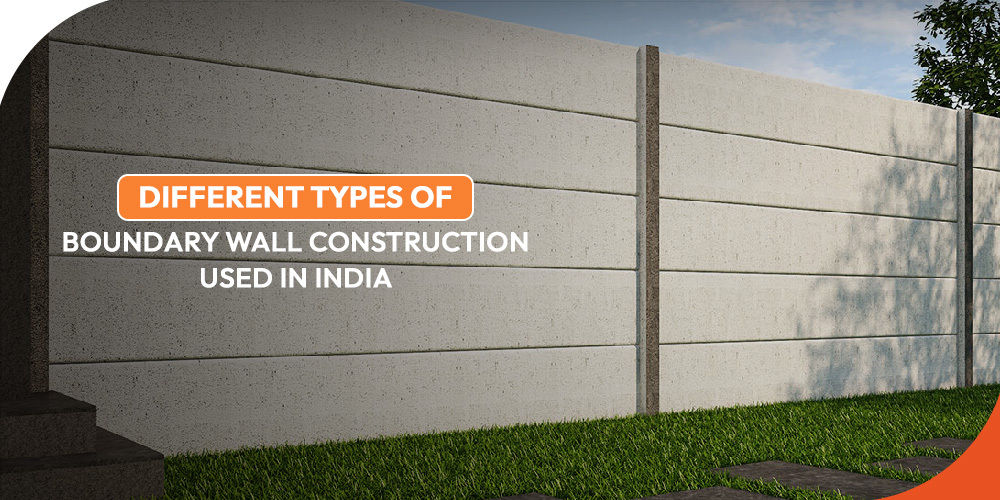
Boundary walls define property limits and provide protection. They are used for residential plots, industrial land, warehouses, agricultural fields, and infrastructure projects. In cities like Pune and across Maharashtra, developers and landowners install boundary walls to secure land, prevent encroachment, and establish clear site limits.
Boundary wall construction methods vary based on materials, site conditions, project scale, and budget. Each type has a different construction process, cost structure, and maintenance requirement.
This guide outlines the main types of boundary wall construction used in India.
Brick Masonry Boundary Wall
Brick masonry boundary walls are widely used for residential plots and small properties. This method uses bricks bonded with cement mortar.
Construction process
- Excavation for the foundation
- PCC base preparation
- Brick laying in cement mortar
- RCC columns at intervals
- Plastering and finishing
Applications
- Residential houses
- Small plots
- Bungalows
- Independent homes
Key considerations
Brick walls require skilled labour and continuous supervision during construction. The process also includes curing and plastering, which increases project duration. Material transportation and labour availability can influence the final cost.
Stone Masonry Boundary Wall
Stone masonry walls are constructed using natural stone blocks bonded with mortar. This method is common in rural areas and farm properties.
Construction method
- Foundation excavation
- Stone placement with mortar
- Layer-by-layer wall construction
Applications
- Agricultural land
- Farmhouses
- Rural properties
- Resorts
Key considerations
Stone walls require large quantities of stone and skilled masons. Construction time is longer compared to modern systems. The wall thickness is usually greater than that of brick construction to maintain stability.
RCC Cast-in-Situ Boundary Wall
RCC cast-in-situ boundary walls are constructed directly at the project site using reinforced concrete.
Construction process
- Excavation and footing preparation
- Installation of reinforcement bars
- Shuttering or formwork installation
- Concrete pouring
- Curing
Applications
- Industrial sites
- Infrastructure projects
- Government facilities
- High-security zones
Key considerations
This construction method requires formwork, reinforcement installation, and curing time. The process involves multiple stages, which can increase construction duration and labour involvement.
Precast Concrete Boundary Wall
Precast boundary walls are manufactured using factory-made concrete panels and RCC posts. The components are produced in controlled conditions and installed at the site.
Construction method
- Foundation pits prepared at column intervals
- RCC columns installed in the foundation
- Precast concrete panels inserted between columns
The wall is assembled using ready components, which reduces on-site construction work.
Applications
- Industrial land
- Warehouses
- MIDC plots
- Agricultural land
- Layout developments
- Infrastructure projects
Key considerations
Precast walls reduce construction time because most elements are produced before installation. The system also requires fewer workers compared with traditional masonry construction.
Metal Fencing Boundary
Metal fencing systems use steel components to create a boundary line around a property.
Common types include:
- Chain link fencing
- Barbed wire fencing
- Steel mesh fencing
Applications
- Agricultural land
- Temporary site boundaries
- Construction projects
- Industrial plots
Key considerations
Metal fencing requires support posts and wire or mesh installation. This system defines property limits but does not provide full privacy.
Wooden Boundary Wall
Wooden boundary walls use timber boards or panels fixed to support posts.
Applications
- Landscape design
- Resorts
- Decorative boundaries
Key considerations
Wood structures require regular maintenance to prevent weather damage and deterioration.
Comparison of Boundary Wall Construction Types
|
|
|
|
|
|
|
|
|
|
|
|
|
|
|
|
|
|
|
|
|
|
|
|
|
|
|
|
|
|
|
|
|
|
|
|
|
|
|
|
|
|
Choosing the Right Boundary Wall Construction
Selecting a boundary wall system depends on project requirements and site conditions. Property owners and contractors typically evaluate several factors before construction begins.
Key factors include
- Land size
- Construction budget
- Security requirement
- Construction timeline
- Maintenance requirements
- Local regulations
For large plots and industrial land, construction speed and labour availability often influence the final decision.
Boundary Wall Construction in Pune and Maharashtra
In regions such as Pune, PCMC, Chakan, Talegaon, and MIDC areas, boundary walls are commonly installed for industrial land, warehouses, agricultural plots, and layout developments.
Traditional brick construction is still used for smaller residential properties. However, many large projects now prefer systems that reduce site work and shorten installation timelines.
Conclusion
Boundary walls are an essential component of property development. They define site limits, provide protection, and support land management.
Different construction methods serve different project requirements. Brick and stone masonry remain common for residential and rural properties. Reinforced concrete walls are used in industrial applications. Precast concrete systems provide an alternative approach where construction speed and site efficiency are priorities.
Understanding the characteristics of each boundary wall construction type helps property owners, developers, and contractors select the system that aligns with project needs.