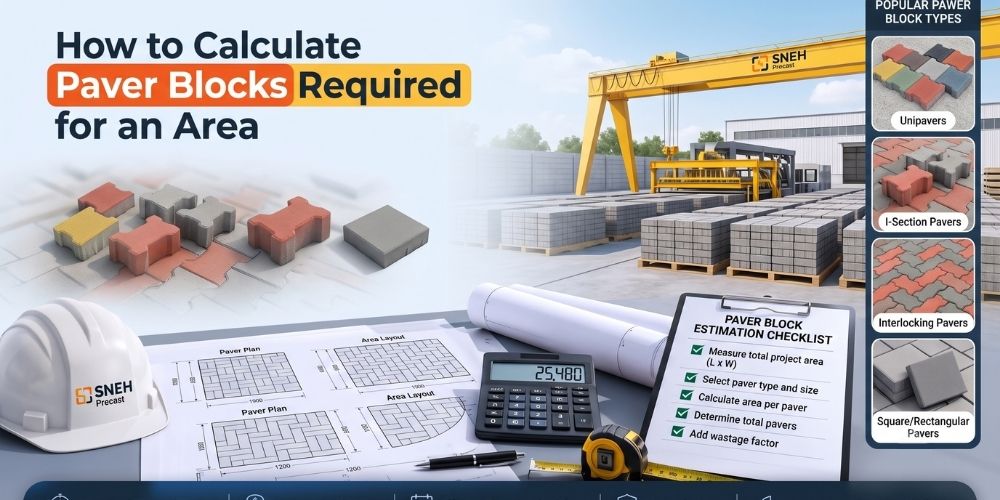
How to Calculate Paver Blocks Required for an Area
Calculating the number of paver blocks required before starting a paving project helps you estimate material requirements, reduce unnecessary purchases and plan installation more efficiently. The quantity depends mainly on the total area to be paved, the dimensions of the selected paver block, the layout pattern and the allowance required for cutting and wastage.
Whether you are planning a driveway, walkway, parking area or other paved surface, the basic calculation follows a simple formula.
What Information Do You Need?
Before calculating the required quantity, collect these measurements:
-
Length and width of the area
-
Length and width of one paver block
-
Total area that needs paving
-
Areas that will not be paved, such as columns or existing structures
-
Allowance for cutting and wastage
The paver blocks selected for the project should also be considered because different shapes and dimensions provide different coverage per square metre.
Step 1: Calculate the Total Area
For a rectangular or square area, use:
Area = Length × Width
For example, if a parking area is 20 ft long and 10 ft wide:
20 × 10 = 200 sq ft
Therefore, the total paving area is 200 sq ft.
For metric measurements:
Area = Length (m) × Width (m)
Make sure all measurements use the same unit before performing the calculation.
Step 2: Calculate the Area Covered by One Paver Block
Next, determine the surface area covered by one paver.
Area of one paver = Paver length × Paver width
For example, consider a paver measuring 200 mm × 100 mm.
Convert the dimensions into metres:
-
200 mm = 0.20 m
-
100 mm = 0.10 m
Therefore:
0.20 × 0.10 = 0.02 m²
One paver covers approximately 0.02 square metres before considering joints and cutting.
When selecting a product, use the actual dimensions provided for the particular paver rather than assuming that all pavers have the same coverage.
Step 3: Calculate the Number of Paver Blocks Required
Once you know the total area and coverage of one paver, use:
Number of Paver Blocks = Total Area ÷ Area Covered by One Paver
For example, if the paving area is 100 m² and each paver covers 0.02 m²:
100 ÷ 0.02 = 5,000 pavers
So, the basic requirement is 5,000 paver blocks.
This is the theoretical quantity and does not yet include cutting, breakage or installation wastage.
Step 4: Add Cutting and Wastage Allowance
A project may require additional pavers because of edge cutting, corners, curves, patterns, handling or accidental breakage. The appropriate allowance depends on the shape and complexity of the project.
For example, if the calculated requirement is 5,000 pavers and you allow 5% additional quantity:
5,000 × 1.05 = 5,250 pavers
The estimated order quantity would therefore be 5,250 pavers.
A simple rectangular area may require less cutting than an area with multiple corners or curved edges. For this reason, wastage should be considered based on the actual site layout.
How Many Paver Blocks Are Required Per Square Metre?
The number of pavers required per square metre depends on their face dimensions.
For example:
| Paver Size | Approx. Coverage | Approx. Pieces per m² |
|---|---|---|
| 200 × 100 mm | 0.02 m² | 50 |
| 200 × 200 mm | 0.04 m² | 25 |
| 225 × 112 mm | 0.0252 m² | About 40 |
These figures are mathematical estimates based on face dimensions. Actual requirements can vary depending on joint spacing, laying pattern and cutting.
Sneh Precast offers different options, including profile pavers, so always check the product's actual dimensions before calculating the final quantity.
Does Paver Size or Thickness Affect Quantity?
Paver length and width directly affect the number of pieces required to cover an area. Larger surface dimensions generally mean fewer pieces are needed per square metre, while smaller pavers require more pieces.
Thickness is different. It does not change the number of pieces required when the length and width remain the same. However, thickness is an important consideration when selecting pavers for a particular application because traffic and load requirements can differ between walkways, driveways and parking areas.
The selected design can also affect the calculation. For example, combination pavers may use multiple shapes or sizes within a layout, requiring calculations based on the complete pattern.
How to Calculate Pavers for an Irregular Area
Not every project has a simple rectangular layout. For an L-shaped, curved or irregular area, divide the site into smaller measurable sections.
For example:
-
Divide the area into rectangles or other simple shapes.
-
Calculate the area of each section.
-
Add the individual areas.
-
Deduct areas that do not require paving.
-
Calculate the required pavers based on the final area.
-
Add an appropriate cutting and wastage allowance.
For complex designs, measuring the site accurately before ordering material is particularly important.
Common Mistakes to Avoid
When estimating paver quantity, avoid these common errors:
-
Mixing square feet and square metres in the same calculation
-
Using incorrect paver dimensions
-
Forgetting to deduct non-paved areas
-
Ignoring cutting and wastage
-
Ordering exactly the calculated quantity without considering site conditions
-
Selecting paver thickness without considering the intended application
A quantity estimate should therefore be based on both accurate measurements and the actual product specifications.
Quick Paver Block Calculation Formula
For a quick estimate, use these four steps:
1. Total Area = Length × Width
2. Paver Area = Paver Length × Paver Width
3. Basic Quantity = Total Area ÷ Paver Area
4. Final Quantity = Basic Quantity + Cutting/Wastage Allowance
The calculation gives you a starting estimate, but final material requirements should be confirmed against the actual site dimensions, selected product and installation pattern.
Need Help Selecting Paver Blocks?
Once you know your approximate area and quantity, the next step is selecting the right paver for the project. Sneh Precast offers range of multiple landscaping solutions, including paving and related products for outdoor applications.
For project-specific requirements, share your area measurements, preferred paver type and application with Sneh Precast to discuss the suitable product and quantity requirements.