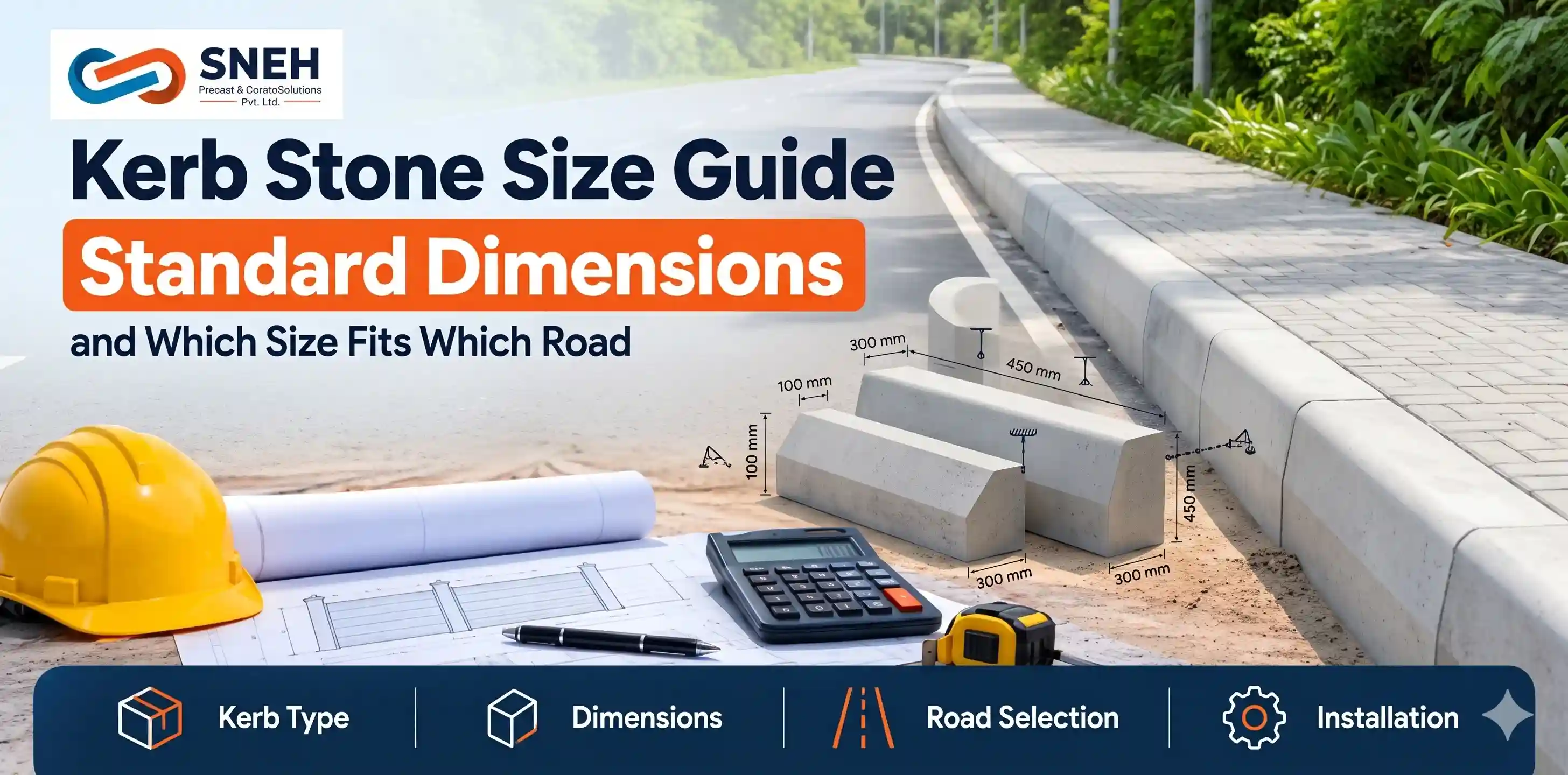
Kerb Stone Size Guide: Standard Dimensions and Which Size Fits Which Road
What is the standard kerb stone size in India?
IS 5758 lists straight kerbs in three sections: 150 x 300 mm, 125 x 250 mm and 100 x 250 mm, each normally 1 m long. The first number is the width of the top face and the second is the height of the vertical face. Edgings are smaller at 50 x 150, 50 x 200 or 50 x 250 mm. Sneh Precast's 1 m L-shaped kerb stone is a manufacturer section: 1,000 mm long and 350 mm high, with a width of 125 mm at the top and 150 mm at the bottom.
What does "kerb stone size" actually mean?
A kerb stone size has three dimensions: length, width and height. In IS 5758 the designation gives the width of the face that lies horizontal after laying first, then the height of the vertical face. A "150 x 300" kerb therefore has a 150 mm wide top and stands 300 mm tall. Length is separate, and the standard sets it at 1 m unless the buyer specifies otherwise.
Two more terms cause confusion. The upstand is the height the kerb shows above the road or channel once laid, which is less than its full height because the base sits in the bed. The batter is the slope on the face of the kerb, which changes the profile but not the nominal designation. Mixing these words up is a common reason a quote does not match what arrives on site.
The publicly available text is the 1984 first revision of IS 5758, so check whether a newer revision applies to your tender. For kerb profiles such as bullnose and half-battered, see Sneh Precast's kerb stone types guide.
IS 5758 kerb sizes in one table
|
Kerb type |
Size, width x height (mm) |
Standard length |
Minimum test load (N) |
|---|---|---|---|
|
Rectangular |
150 x 300 |
1 m |
22,750 |
|
Rectangular |
125 x 250 |
1 m |
13,600 |
|
Rectangular |
100 x 250 |
1 m |
9,100 |
|
Splayed |
150 x 300 |
1 m |
22,750 |
|
Splayed |
125 x 250 |
1 m |
13,600 |
|
Half-batter |
150 x 300 |
1 m |
22,750 |
|
Half-batter |
125 x 250 |
1 m |
13,600 |
|
Half-section |
150 x 125 |
1 m |
8,200 |
|
Channel |
250 x 125 |
1 m |
13,600 |
|
Edging |
50 x 250 |
1 m |
3,180 |
|
Edging |
50 x 200 |
1 m |
2,720 |
|
Edging |
50 x 150 |
1 m |
2,040 |
Source: IS 5758 (1984), clauses 4.2 to 4.4 and Table 1. The test loads are transverse strength loads held for one minute at 28 days. Sneh Precast's 1 m L-shaped kerb stone sits outside this table: it is a manufacturer section, 350 mm high and 125 to 150 mm wide, and it is listed under pre-stressed kerb stones. Always quote the exact section you want and not just the word "standard".
Why do websites quote different kerb sizes?
Because "kerb stone" names more than one product, and sources mix them. One supplier page says standard kerb stones in India run 300 to 450 mm high, 100 to 150 mm thick and 400 to 600 mm long. Another guide gives a standard of 450 x 300 x 150 mm. Marketplace listings show 300 x 300 x 150 mm and 450 x 300 x 100 mm pieces.
Three different products sit behind these numbers:
- IS 5758 sections: 1 m long, with the widths and heights in the table above.
- Short kerb blocks: pieces of roughly 300 to 600 mm sold by the piece for landscaping and footpath edges.
- Manufacturer sections: special profiles such as an L-shaped kerb, made to the maker's own drawing.
None of the three is wrong, but they are not interchangeable. When you ask for a quote, give width, height, length, profile and grade. Ask the supplier to confirm each one in writing.
Which kerb size fits which location?
Use this table as a starting point, then confirm with your road or site engineer.
|
Location |
Suggested section |
|---|---|
|
Garden and path edges |
Edging, 50 x 150 to 50 x 250 mm |
|
Footpaths, parking bays and internal roads |
100 x 250 or 125 x 250 mm, rectangular or half-batter |
|
Carriageway edges and medians |
150 x 300 mm, the largest IS 5758 section with the highest test load |
|
Curves and roundabouts |
Round or radius kerbs |
Sneh Precast's kerb stones matches products to places in the same way: the 1 m L-shaped kerb for road edges, footpaths and parking areas, the round kerb for roundabouts and garden edges, and the divider kerb for medians.
Weight matters too. Treating each section as solid concrete at 2,400 kg per cubic metre, a 1 m piece of 150 x 300 weighs about 108 kg, a 125 x 250 piece about 75 kg and a 100 x 250 piece about 60 kg. A kilometre of kerb (1,000 pieces) therefore weighs about 108, 75 or 60 tonnes, which is roughly 11, 8 or 6 truckloads at 10 tonnes. Pieces 100 kg need two people or a lifting aid, so plan the unloading before the truck arrives.
Kerb glossary: terms you will see in quotes
-
Upstand: the height of the kerb face above the road or channel after laying.
- Batter: the slope given to the face. Half-batter kerbs have a partly sloped face, and IS 5758 lists them in two sections.
- Splayed kerb: a kerb with an angled face, listed in IS 5758 in two sections.
- Bullnose: a kerb with a rounded top edge that softens the corner.
- Half-section kerb: a smaller 150 x 125 mm section.
- Channel: a shallow section, 250 x 125 mm in IS 5758, that carries water along the road edge.
- Edging: a small section, 50 x 150 to 50 x 250 mm, that separates two surfaces.
- Quadrant: a curved corner unit used where two kerb lines meet.
- Bed and haunching: the mortar or concrete under and behind a kerb that holds it in position.
- Transverse strength: the bending load, in newtons, that a kerb must carry for one minute in the standard's 28 day test.
What to put in a kerb stone quote request
-
Type and profile: rectangular, splayed, half-batter, bullnose, flush, L-shaped, round or divider.
- Section: width x height in mm, and length (1 m is the IS 5758 default).
- Quantity: pieces and metres run.
- Strength: the grade and the test load you need, using the loads in the table above as a reference.
- Curves: radius, and any cut or special pieces.
- Site location: delivery charges depend on distance and weight.
- Unloading: by hand, crane or hydra, and whether the supplier includes it.
- Delivery date: the day you need the first load.
Sneh Precast's kerb range includes pre-stressed and hydraulic kerb stones (full batter, half batter, bull nose and flush), the 1 m L-shaped kerb, round kerbs and divider kerbs. Send your list through the kerb stones for a quote. Pair kerbs with paving using our paver block thickness guide.
Conclusion: read the size, then confirm it in writing
Read a kerb size as width first and height second, then check the length, the profile and the strength. IS 5758 lists 150 x 300, 125 x 250 and 100 x 250 mm as the straight sections, with smaller edgings for garden and path borders. Because websites quote different sizes for different products, put every dimension in your quote request and plan unloading for heavy 1 m pieces.