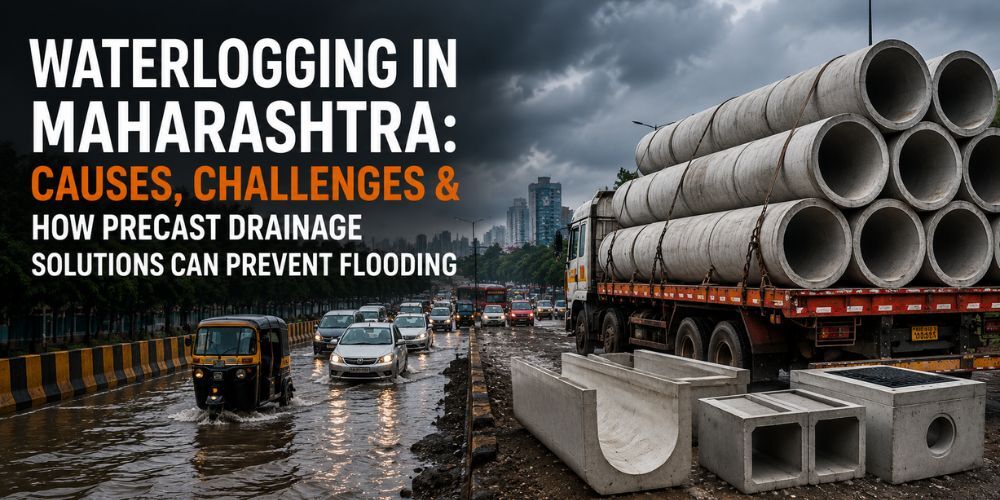
Waterlogging in Maharashtra: Causes, Challenges & How Precast Drainage Solutions Can Prevent Flooding
Every monsoon, waterlogging disrupts daily life across Maharashtra. Roads become inaccessible, traffic slows down, public transport is affected, and commercial activity is interrupted. Cities such as Mumbai, Pune, Nagpur, Thane, Nashik, and rapidly urbanising regions continue to report recurring flooding despite ongoing investments in drainage infrastructure.
The Maharashtra State Disaster Management Authority identifies urban flooding as a growing challenge driven by heavy rainfall, encroachment on natural drainage paths, and inadequate drainage systems. Cities including Mumbai, Pune, and Nagpur have experienced repeated urban flooding events during recent monsoons.
The question is no longer whether Maharashtra receives heavy rainfall. The question is whether existing infrastructure is capable of managing it.
Maharashtra's Urban Growth and Drainage Gap
Over the last two decades, Maharashtra has experienced rapid urbanization.
New residential developments, industrial corridors, logistics parks, IT hubs, highways, and commercial zones have expanded across the state. However, drainage infrastructure has not always expanded at the same pace.
In several cities, drainage systems were originally designed for lower population densities, lower built-up areas, and different rainfall patterns. As urban surfaces become increasingly paved, rainwater infiltration decreases and surface runoff increases.
This creates greater pressure on stormwater networks during high-intensity rainfall events.
What Is Driving Waterlogging in Maharashtra?
Aging Drainage Infrastructure
Many drainage networks were constructed decades ago and continue to operate under capacities that may not match present-day requirements.
For example, infrastructure upgrade programs in cities such as Thane have specifically targeted aging sewer and stormwater systems that are no longer sufficient for current urban conditions.
Encroachment on Natural Drainage Systems
Urban development has altered natural water flow paths in many locations.
Studies and municipal assessments have repeatedly identified encroached nullahs, disappearing streams, and blocked drainage corridors as major contributors to urban flooding. In Pune, experts have linked increasing flood-prone locations to faulty stormwater planning and encroachments on natural drainage channels.
Drain Blockages and Maintenance Challenges
Drainage performance depends not only on design but also on maintenance.
A Pune Municipal Corporation audit found that clogged drains, accumulated waste, and inadequate drainage systems contributed significantly to flooding at multiple locations across the city.
This highlights an important issue:
Building drainage infrastructure alone is not enough. Infrastructure must also remain accessible for inspection, cleaning, and maintenance.
Climate and Rainfall Patterns
Urban flooding is increasingly associated with high-intensity rainfall occurring within short durations.
According to the Government of India, urban flooding is often caused by intense rainfall combined with inadequate drainage systems, encroachment of water bodies, and unplanned urban growth.
As rainfall intensity increases, drainage systems designed for historical conditions face additional stress.
Government Spending on Flood Mitigation
Waterlogging is not being ignored.
Government agencies at the state and local levels continue to allocate significant budgets for drainage infrastructure, stormwater management, and flood mitigation projects.
Recent examples include:
-
₹326.76 crore sanctioned for stormwater drainage systems in newly merged Pune Municipal Corporation villages under AMRUT 2.0.
- ₹350 crore proposed for upgrading aging sewer and drainage infrastructure in Thane.
- Ongoing investments through AMRUT and other urban infrastructure programs that include rainwater channels and drainage improvements.
These projects indicate that drainage infrastructure remains a major public investment priority.
Why Does Waterlogging Continue Despite Infrastructure Spending?
The answer is not simply funding.
Several engineering and planning challenges remain:
Infrastructure Expansion vs Urban Growth
Cities are expanding rapidly, often faster than drainage infrastructure can be upgraded.
Fragmented Infrastructure Networks
In several urban areas, roads, drainage systems, utilities, and development approvals may be managed by different agencies, creating coordination challenges. Flooding concerns in areas such as Hinjewadi have highlighted these issues.
Legacy Systems
Many existing drainage systems were designed for older development patterns and lower runoff volumes.
Execution and Maintenance
Drainage networks require regular inspection, cleaning, and rehabilitation. Without maintenance access, performance declines over time.
Rainfall Intensity
Infrastructure designed decades ago may not adequately accommodate present rainfall events.
The Cost of Waterlogging
Waterlogging creates impacts beyond flooded roads.
Transportation
Flooding increases travel times, affects public transport reliability, and disrupts logistics operations.
Research on urban flooding shows that even limited flooding can cause widespread traffic delays and productivity losses across transportation networks.
Public Infrastructure
Standing water accelerates deterioration of roads, pavements, utility corridors, and public assets.
Economic Activity
Businesses face operational interruptions, supply chain disruptions, and accessibility challenges during major flooding events.
Public Health
Water accumulation increases the risk of mosquito breeding and sanitation-related concerns.
What Should Future Drainage Infrastructure Focus On?
Infrastructure planning increasingly focuses on:
- Hydraulic capacity
- Faster project delivery
- Maintenance accessibility
- Long service life
- Reduced disruption during installation
- Climate resilience
These requirements influence how stormwater systems are designed and constructed.
The Role of Precast Drainage Systems
Precast concrete systems are increasingly used in drainage and stormwater projects because components are manufactured before arriving at the site and installed as part of a planned drainage network.
Applications include:
Precast U Drains
Used for roadside drainage, industrial developments, residential projects, and infrastructure corridors.
RCC Box Culverts
Used to convey stormwater beneath roads, highways, and transportation corridors.
Catch Pits
Used to collect debris and sediment before they enter the drainage network.
Inspection Chambers and Manholes
Provide access for maintenance and cleaning activities.
Underground Stormwater Storage Structures
Used to temporarily retain excess rainwater during peak rainfall periods.
The effectiveness of any drainage system depends on engineering design, hydraulic analysis, installation quality, and maintenance planning. Precast systems can support these objectives by providing standardized and repeatable infrastructure components.
Infrastructure Requires Planning, Not Seasonal Repairs
Waterlogging is often discussed as a monsoon problem.
In reality, it is an infrastructure planning challenge.
The long-term response requires:
- Accurate drainage mapping
- Hydraulic design based on current rainfall data
- Protection of natural drainage corridors
- Maintenance access
- Capacity upgrades
- Integration of drainage systems into urban development planning
Without these measures, annual spending alone may not eliminate recurring flooding.
Conclusion
Maharashtra continues to invest in drainage and flood mitigation infrastructure. However, urban growth, aging networks, maintenance challenges, and changing rainfall patterns continue to place pressure on existing systems.
Reducing waterlogging requires a combination of planning, engineering, execution, and long-term asset management.
For infrastructure developers, municipalities, consultants, and contractors, drainage systems are no longer secondary utilities. They are a core component of urban resilience.
Through products such as precast U-drains, RCC box culverts, catch pits, inspection chambers, and stormwater management structures, Sneh Precast and ConstoSolutions contribute to drainage infrastructure projects designed to improve water movement, maintenance access, and network reliability.
The objective is not simply to manage rainfall during a single monsoon season. The objective is to build infrastructure that can continue to perform over the coming decades.