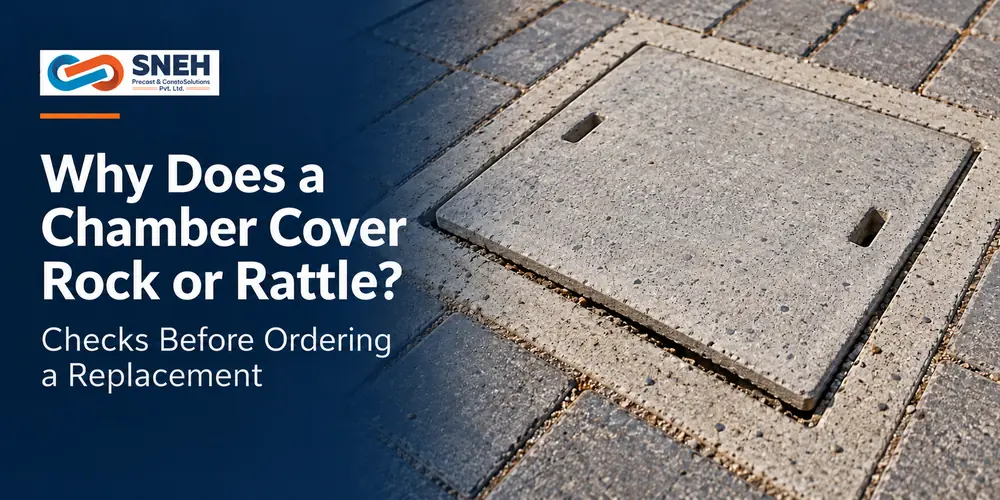
Why Does a Chamber Cover Rock or Rattle? Checks Before Ordering a Replacement
A chamber cover that clicks as vehicles pass or sits unevenly needs attention. However, ordering a replacement without inspecting the surrounding installation can leave the problem unresolved.
A chamber cover usually rocks or rattles because it does not sit evenly on its supporting surface. Trapped debris, damaged seating edges, an incompatible cover and frame, or unstable support beneath the frame can all contribute to movement. Checking the complete assembly helps establish what actually needs repair or replacement.
For housing societies, commercial premises and industrial sites in Pune, this inspection can also provide the information a supplier needs to assess a replacement enquiry.
Keep people and vehicles away from an unstable or damaged cover until it has been assessed. Do not test it by standing on it or driving over it. Competent maintenance personnel should handle lifting and inspection using suitable equipment, with the opening protected throughout the work.
Why Does a Chamber Cover Rock or Rattle?
The first task is to locate the movement. A loose chamber cover and a loose supporting frame may produce similar sounds, but they require different responses.
Identify Whether the Cover or Frame Is Moving
Ask the inspecting contractor to establish whether the lid moves within its seating or whether the surrounding frame moves with it.
Movement confined to the lid calls for closer examination of its contact surfaces and fit. Movement involving the frame calls for investigation of the support underneath.
Record when the rattling began. Did it follow drainage maintenance, nearby paving work or a change in vehicle access? These observations give the contractor useful context without assuming the cause.
Check for Debris on the Seating Surface
Sand, small stones and construction residue may obstruct the surfaces where the lid rests. The top can appear reasonably level even when an obstruction underneath prevents correct seating.
EJ’s maintenance guidance identifies accumulated debris and surface rust on mating surfaces as issues that require attention in applicable cover systems.
The maintenance team should inspect and clean the contact areas according to the manufacturer’s instructions. Cleaning must avoid damaging the seating surfaces or pushing debris into the chamber.
If the cover continues to move after proper cleaning and reseating, the inspection should continue.
Inspect Damaged or Worn Seating Edges
Inspect the underside and edges as well as the visible top. Depending on the cover’s material and construction, concerns can include cracked sections, chipped concrete, worn contact areas or distortion.
For assemblies fitted with hinges, locks, gaskets or seating inserts, those components also need assessment. Manufacturer maintenance guidance treats these as separate inspection items because the condition of each can affect the assembly’s operation.
Record defects with clear photographs. A surface image alone may not show why a cover is unstable.
Check Cover and Frame Compatibility
An existing lid may have been replaced previously with a similar-looking component. That does not establish that it matches the supporting frame.
Check any manufacturer markings, model information or previous purchase records. Where compatibility is uncertain, ask the supplier to review the dimensions and seating arrangement before recommending another lid.
Avoid assuming that covers from different ranges are interchangeable because their stated sizes appear identical.
Examine Bedding and Settlement Beneath the Frame
The installation beneath the frame matters as much as the visible cover. Inspect the surrounding concrete or paving for cracks, gaps and changes in level.
PAM’s installation guidance for its framed access covers emphasises suitable support and adequate bedding strength before traffic returns. Its detailed requirements are product-specific, so the contractor should follow the instructions applicable to the actual installation.
Where deterioration extends below the seating, the assessment may also need to include the supporting structure, including precast manhole chambers where installed.
What Should You Check Before Ordering a Replacement?
Once the cause has been assessed, prepare a replacement brief that describes the existing installation and its intended use. This helps the supplier evaluate fit and suitability.
Measure the Opening, Cover and Supporting Frame
A description such as “600 mm cover” can be ambiguous. It might refer to the clear opening or the outside dimensions of a component.
Have a competent person record the following:
| Detail | Information to provide |
|---|---|
| Clear opening | The unobstructed opening beneath the cover |
| Cover dimensions | Overall length and width, or diameter |
| Cover thickness | The existing component’s thickness |
| Frame or supporting seat | Dimensions, depth, profile and visible condition |
| Identification | Manufacturer, model and readable markings |
| Existing arrangement | Photographs and a dimensioned sketch |
The seating profile and frame condition matter alongside the measurements. Similar nominal sizes do not guarantee that a replacement chamber cover will fit correctly. hongkeglobal.com
Confirm Traffic Conditions and Load Requirements
Describe how the location is used. Include regular traffic and occasional access by delivery, service or maintenance vehicles.
For example, a cover on an internal pathway may have different requirements from one positioned where vehicles turn into a loading area. The supplier and project professional need this context when reviewing the specification.
Sneh Precast’s chamber lid options include Medium Duty (T10) and Heavy Duty (T25) variants, with plain and perforated designs. Request the relevant technical information and confirmation of suitability for the intended installation. A product label alone should not be treated as approval for a particular vehicle or site condition.
Decide Whether Repair or Replacement Is Needed
Use the inspection findings to agree on the scope of work.
| Inspection finding | Next step to discuss |
|---|---|
| Debris obstructing the seating | Cleaning, correct reseating and reassessment |
| Damaged lid with serviceable support | A supplier-confirmed compatible replacement |
| Damaged or incompatible frame | Assessment of a matched replacement assembly |
| Loose frame or deteriorated bedding | Repair of the supporting installation |
| Different traffic requirements | Review of the complete product specification |
Before accepting a replacement concrete component, review the relevant checks for precast concrete product quality. The existing guide covers dimensional verification, visible condition and quality documentation.
Avoid improvised packing with timber, loose stones or scrap rubber. Any seating insert or repair method should be suitable for the specific assembly.
Prepare Photographs and Details for the Supplier
Bring the inspection information together in one enquiry. Include photographs of the overall location, visible damage, product markings and supporting arrangement, alongside the measurements and traffic description.
State whether the enquiry is for a lid alone or whether the frame and supporting installation also require assessment. Include the quantity, delivery location and any unloading constraints.
Sneh Precast states that chamber-lid pricing varies according to size, quantity and delivery location, with the final price confirmed after discussion. A complete enquiry provides a clearer basis for that quotation.
Check the Completed Installation Before Reopening
Ask the installer to confirm correct seating, sound support and completion of the specified installation checks. Where bedding or surrounding concrete has been repaired, establish when the area can reopen to its intended traffic.
Keep the approved product details, installation records and completion photographs. These give future maintenance teams a useful reference if noise or movement returns.
For a chamber cover replacement enquiry in Pune, contact Sneh Precast with your measurements, photographs and inspection findings so the product requirement can be reviewed.