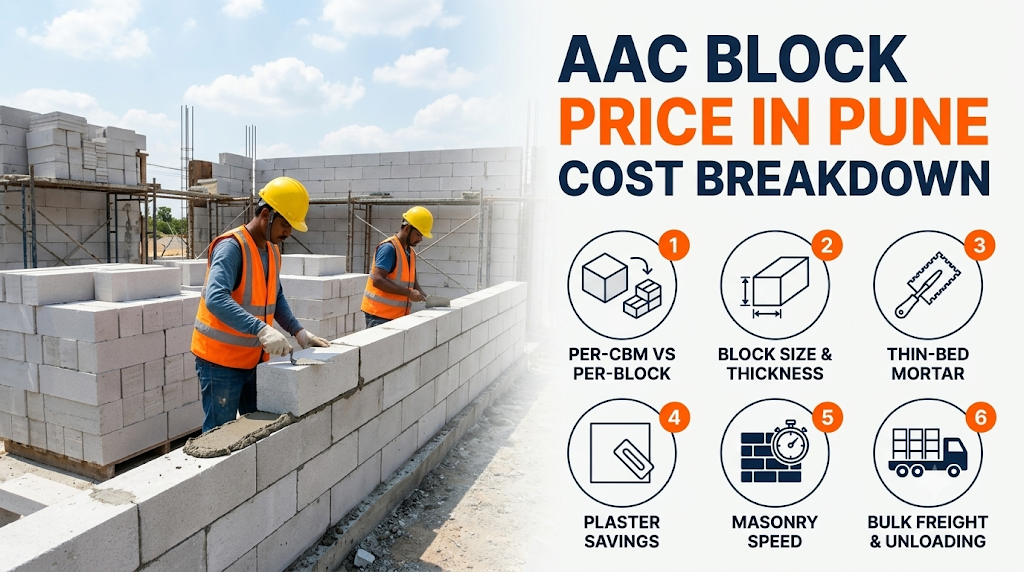
AAC Block Price in Pune: Per-CBM vs Per-Block Rates and Total Wall Cost Breakdown
AAC block price in Pune is quoted primarily per cubic meter (CBM), with Sneh Precast's published indicative ex-factory rate starting at Rs 3,800 per CBM (minimum order 25 CBM, excluding GST and transport).
Per-block price changes sharply with block thickness because a standard 600 x 200 mm AAC block yields 83.3 blocks per CBM at 100 mm thickness (4-inch wall) but only 41.6 blocks per CBM at 200 mm thickness (8-inch wall).
Evaluating total finished wall cost (AAC blocks + thin-bed block jointing mortar + thinner gypsum or cement plaster + lower structural dead load) gives a far more accurate picture than comparing per-piece block rates alone.
For sites within 400 km of Pune, ordering full truckloads (25 to 30+ CBM) keeps freight per CBM economical while minimizing transit edge chipping.
Understanding AAC Block Price in Pune: Why CBM Matters More Than Per-Piece Rates
Autoclaved Aerated Concrete (AAC) blocks have become the standard walling material for residential towers, commercial IT parks, hospitals and industrial facilities across Pune, PCMC and western Maharashtra. Yet when builders request quotes for AAC block price in Pune, confusion often starts immediately because some traders quote per piece while manufacturers quote per cubic meter (CBM).
Quoting per CBM is the industry standard under IS 2185 (Part 3) because every standard AAC block shares the same face dimensions (600 mm length x 200 mm height) while varying in thickness (100 mm, 125 mm, 150 mm, 200 mm or 225 mm). A single CBM of concrete material costs virtually the same to autoclave regardless of how many slices the wire-cutter makes. Consequently, comparing suppliers on a per-CBM basis (ex-factory plus GST plus freight) is the only apples-to-apples method for procurement teams.
Worked Conversion Table: Exact Blocks per CBM and Per-Block Cost
Using Sneh Precast's published indicative ex-factory base rate of Rs 3,800 per CBM (for bulk orders starting at 25 CBM, excluding GST and transport), the table below shows exact mathematical conversions across standard wall thicknesses. You can verify available dimensions and technical specifications on our AAC Blocks product page.
|
Block Size (L x H x T in mm) |
Common Wall Use |
Volume per Block (CBM) |
Exact Blocks per CBM |
Indicative Ex-Factory Price per Block (at Rs 3,800/CBM) |
Wall Area Covered per CBM |
|
600 x 200 x 100 mm (4 inch) |
Internal partitions and dry walls |
0.0120 |
83.33 blocks |
Rs 45.60 / block |
10.00 sq m (107.6 sq ft) |
|
600 x 200 x 125 mm (5 inch) |
Internal load-free partition walls |
0.0150 |
66.67 blocks |
Rs 57.00 / block |
8.00 sq m (86.1 sq ft) |
|
600 x 200 x 150 mm (6 inch) |
Standard external and internal walls |
0.0180 |
55.56 blocks |
Rs 68.40 / block |
6.67 sq m (71.8 sq ft) |
|
600 x 200 x 200 mm (8 inch) |
Exterior walls and acoustic zones |
0.0240 |
41.67 blocks |
Rs 91.20 / block |
5.00 sq m (53.8 sq ft) |
|
600 x 200 x 225 mm (9 inch) |
Heavy exterior and boundary walls |
0.0270 |
37.04 blocks |
Rs 102.60 / block |
4.44 sq m (47.8 sq ft) |
Always double-check block face length and height before applying these numbers. While 600 x 200 mm is the most common size in Pune, some manufacturers supply 625 x 240 mm blocks, which changes the block count per CBM even though the cubic-meter rate stays identical.
Total Finished Wall Cost: Why Per-Block Price Alone Misleads Buyers
Looking purely at the invoice price of an AAC block versus clay bricks misses the biggest savings on modern RCC framed buildings. Because AAC blocks are roughly one-third the weight of conventional red clay bricks and are wire-cut to tight dimensional tolerances (plus or minus 1.5 mm), they slash hidden masonry and structural costs:
|
Cost Factor (Per 100 Sq Ft of 150 mm Wall) |
AAC Blocks + Thin-Bed Adhesive |
Conventional Red Clay Bricks + Cement Mortar |
Project Impact |
|
Jointing Material |
Polymer-modified thin-bed mortar (3 mm to 4 mm joint); zero water curing needed |
Conventional 1:6 cement-sand mortar (10 mm to 12 mm joint) + 7 to 14 days curing |
Saves sand, cement, curing water and curing labour |
|
Plastering Thickness |
Internal direct gypsum (8 mm to 10 mm) or thin cement plaster; flat wall face |
Thick 12 mm to 20 mm cement-sand plaster required to hide uneven bricks |
Up to 30% to 40% lower plastering material consumption |
|
Masonry Speed |
Large 600 x 200 mm units lay 2x to 3x faster per mason per day |
Small bricks require 5x more joints and slower daily output |
Faster floor cycle times and lower shuttering/overhead costs |
|
Structural Dead Load |
Oven-dry density ~550 to 650 kg/m3 reduces RCC column and footing steel |
Heavy clay bricks (~1,800 to 1,900 kg/m3) increase dead load on frame |
Structural engineers can optimize RCC steel and concrete |
|
Breakage & Wastage |
Low when handled with flat trolleys (typically 2% to 4%) |
Higher breakage during dumping and chasing (often 8% to 12%) |
Cleaner site and lower debris disposal cost |
To achieve crack-free masonry walls and realize these mortar savings, pair AAC blocks with a polymer-modified block jointing mortar rather than thick site-mixed cement mortar. Read our step-by-step Block Jointing Mortar Guide for mixing ratios and notched-trowel application rules. If you are still deciding between walling materials for a new build, review our detailed comparison of AAC Blocks vs Red Bricks.
Key Factors That Move AAC Block Quotes Up or Down
Even within Pune, two AAC block quotes can differ by Rs 200 to Rs 500 per CBM. Check these five technical variables before picking the lowest quote:
- Compressive Strength (Grade 1 vs Grade 2 under IS 2185 Part 3): Grade 1 blocks deliver higher compressive strength (typically 4.0 to 4.5 N/mm2) compared to Grade 2 (3.0 N/mm2), reducing handling breakage and supporting heavier wall fixtures.
- Raw Material Consistency (Fly Ash Quality): Consistent fly ash fineness and lime-gypsum ratios prevent surface powdering and excessive drying shrinkage cracks after plastering.
- Autoclaving Cycle Discipline: Rushed steam curing leaves internal moisture high and strength low. Reputable suppliers dispatch properly cured batches with verified test reports.
- GST and Billing Transparency: Confirm whether the quoted Rs/CBM rate is exclusive of GST (verify the applicable HSN rate on your formal tax invoice) and whether unloading labour is included.
- Minimum Order Quantity and Truck Utilization: Full truckloads (25 CBM and above) spread freight costs efficiently. Partial loads incur dead-freight charges that inflate the effective per-CBM price.
Procurement Checklist for Outstation Buyers Within 400 km of Pune
Developers and industrial contractors in Mumbai, Navi Mumbai, Nashik, Satara, Kolhapur, Sangli, Solapur, Ahmednagar and Chhatrapati Sambhajinagar frequently source AAC blocks from Pune plants for assured quality and steady bulk availability. Use this checklist to keep outstation deliveries damage-free:
- Plan Full-Truck Dispatches: Consolidate walling schedules so every dispatch hits 25 CBM to 35 CBM, maximizing payload per kilometer.
- Verify Breakage Allowance in the PO: Clarify acceptable transit chipping thresholds and proper strapping or stacking inside the truck bed before dispatch.
- Prepare Flat Unloading Bays: Never dump AAC blocks like clay bricks. Arrange manual hand-unloading or forklift pallet access onto flat, dry ground close to the hoist.
- Protect Stored Blocks From Rain: Stack blocks on wooden runners or raised pallets and cover the tops with tarpaulin during monsoon months so blocks stay dry before laying with thin-bed adhesive.
- Bundle Block Jointing Mortar in the Same Order: Sourcing AAC blocks alongside polymer-modified block jointing mortar (such as Sneh Precast's Consto Mortar Solutions) simplifies vendor coordination and guarantees chemical compatibility.
Why Builders Source AAC Blocks and Mortar Solutions From Sneh Precast
Operating from Pune since 2008, Sneh Precast & Constosolutions Pvt. Ltd. is a trusted precast concrete and walling partner for builders, industrial developers and infrastructure contractors across Maharashtra. Backed by ISO 9001:2015, ISO 14001:2015 and OHSAS 45001:2018 certifications, we supply IS-code-compliant AAC blocks, solid concrete blocks, hollow blocks, fly ash bricks and ready-mix Consto mortar products engineered for consistent strength and clean site execution.
With over 17 years in the industry and major project experience spanning real estate developments, IT parks, corporate campuses and expressway works, we support bulk supply across a 400 km radius from Pune (with custom logistics beyond 400 km). Standard walling orders typically dispatch within 1 to 2 weeks, supported by responsive technical guidance and after-sales service.
Frequently Asked Questions
What is the current indicative AAC block price in Pune per CBM?
Sneh Precast's published indicative ex-factory rate for AAC blocks in Pune starts around Rs 3,800 per CBM for bulk orders (minimum 25 CBM), excluding applicable GST and transport. Final landed cost depends on delivery distance and order volume.
How many 6-inch (150 mm) AAC blocks are in 1 CBM?
For standard 600 x 200 x 150 mm AAC blocks, 1 CBM contains exactly 55.56 blocks (rounded to 55 or 56 blocks), which builds approximately 71.8 sq ft of 6-inch wall area.
Can I use regular cement-sand mortar with AAC blocks?
While conventional mortar can be used, polymer-modified thin-bed block jointing mortar (3 mm to 4 mm thickness) is strongly recommended. It bonds faster, eliminates curing water, prevents thermal bridging and reduces wall shrinkage cracks.
What is the minimum order quantity for AAC blocks from Sneh Precast?
Sneh Precast's standard minimum order quantity for bulk AAC block supply is 25 CBM, which aligns with economical full-truckload delivery across Pune and nearby Maharashtra cities.
Does Sneh Precast deliver AAC blocks outside Pune?
Yes. We supply AAC blocks and Consto mortar products across a 400 km radius from Pune, including Mumbai, Nashik, Satara, Kolhapur, Sangli, Solapur and Chhatrapati Sambhajinagar, with freight calculated transparently based on distance and load size.