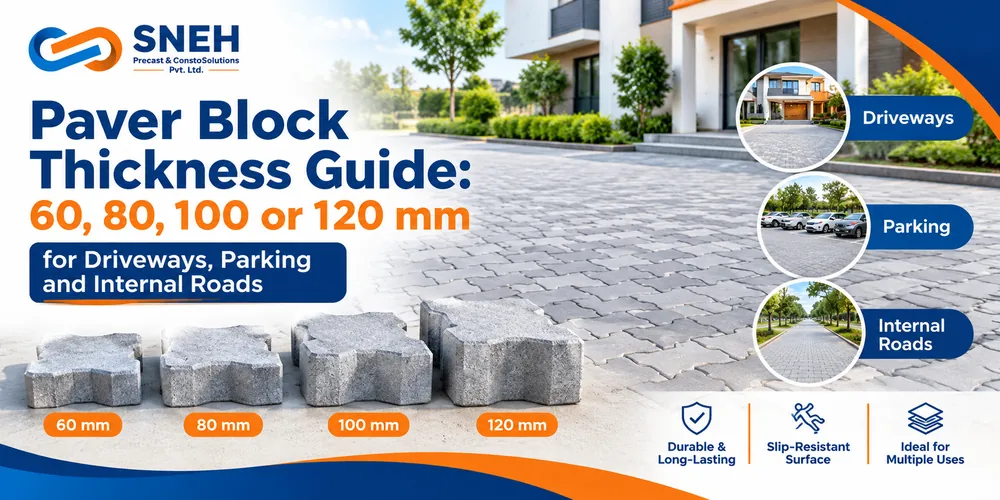
Paver Block Thickness Guide: 60, 80, 100 or 120 mm for Driveways, Parking and Internal Roads
Choose 60 mm for footpaths, gardens and patios. Choose 80 mm for home driveways, car parking and society roads. Choose 100 mm where tempos, delivery vans or light trucks drive over the surface. Use 120 mm only for very heavy traffic and only after an engineer approves the base design. IS 15658:2021 links each thickness to a strength grade and a traffic category, so ask your supplier for both numbers before you order.
What does paver thickness change, and what does it not?
Thickness changes how well a single block spreads a wheel load into the base. A thicker block resists tilting when a tyre crosses its edge. Its taller sides give neighbouring blocks more face to lock against. It does not change how many blocks you need per square foot, because the plan size stays the same. Sneh Precast's paver quantity guide makes the same point.
Three other things decide how long the surface lasts: the strength grade of the concrete, the compacted base underneath and the edge restraint around the paving. A 100 mm block on a loose base can fail sooner than a 60 mm block on a well-compacted one. Treat thickness as one input and not the whole answer.
Sneh Precast lists zig-zag pavers in 60, 80 and 100 mm with a 225 x 112.5 mm plan size. Its paver blocks custom size and thickness are available on request and that thickness affects price. Matching thickness to real traffic therefore keeps the budget honest.
Paver block thickness by use: a quick reference
|
Where the pavers go |
Typical traffic |
Suggested thickness |
Grade to ask for |
|---|---|---|---|
|
Footpaths, gardens, patios |
Pedestrians |
60 mm |
M30 or M35 |
|
Home driveway and car parking |
Cars and two-wheelers, an occasional SUV |
60 to 80 mm, and 80 mm if cars park and turn every day |
M35 or M40 |
|
Society roads and visitor parking |
Cars, an occasional tempo or water tanker |
80 mm |
M40 |
|
Loading areas and light commercial yards |
Vans, tempos, light trucks |
100 mm |
M40 to M50 |
|
Container yards, bus bays, industrial roads |
Heavy and very heavy vehicles |
100 to 120 mm on an engineered base |
M50 or M55 |
The thickness column is a practical rule of thumb. The grade and minimum thickness pairs come from Table 1 of IS 15658:2021, explained in the next section. The standard's own application examples place domestic drives, paths and patios under M30 at 50 mm, so 60 to 80 mm is a deliberate margin and not a minimum. Where trucks use the surface, have a pavement engineer confirm the design.
What does IS 15658:2021 say about grade and thickness?
IS 15658:2021, titled Concrete Paving Blocks: Specification, classifies blocks by grade, 28-day compressive strength, traffic category and minimum thickness. Table 1 pairs them as follows:
- M30 (30 MPa): non-traffic, minimum 50 mm.
- M35 (35 MPa): light traffic, minimum 60 mm.
- M40 (40 MPa): medium traffic, minimum 80 mm.
- M50 (50 MPa): heavy traffic, minimum 100 mm.
- M55 (55 MPa): very heavy traffic, minimum 100 mm. The 2021 revision lowered this from 120 mm.
The 2021 text defines very heavy traffic as more than 1,500 commercial vehicles a day above 30 kN laden weight, or more than 5.0 million standard axles over a 20 year design life. The older 2006 table put light traffic below 0.5 msa, medium traffic at 0.5 to 2.0 msa and heavy traffic at 2.0 to 5.0 msa.
Many websites still show the 2006 table, in which M55 needs 120 mm. Check which edition your tender cites. Blocks thicker than 120 mm can be made when the buyer and manufacturer agree.
Worked example: how thickness changes weight and truck loads
For a buyer far from the factory, thickness also changes how many trucks you pay for. Assume a 225 x 112.5 mm block (the size on Sneh Precast's zig-zag page), concrete at 2,400 kg per cubic metre and a 10 tonne truck payload. These weights are calculated, so ask your supplier for actual unit weights.
|
Thickness |
Weight per block |
Weight per sq ft |
Sq ft per 10 tonne truck |
Trucks for 5,000 sq ft |
|---|---|---|---|---|
|
60 mm |
3.6 kg |
13.4 kg |
about 747 |
7 |
|
80 mm |
4.9 kg |
17.8 kg |
about 560 |
9 |
|
100 mm |
6.1 kg |
22.3 kg |
about 448 |
12 |
|
120 mm |
7.3 kg |
26.8 kg |
about 373 |
14 |
Moving from 60 mm to 100 mm lifts the truck count from 7 to 12 on a 5,000 sq ft job. On a haul of 200 to 400 km, five extra trips cost real money. Choose the thinnest block that your grade table and traffic justify. Do not pay for 100 mm in a car-only area. The logic also works the other way: do not cut thickness to save freight when trucks will use the surface.
Five mistakes and three myths about paver thickness
Mistakes to avoid
-
Choosing by price alone. A thin block is cheaper per sq ft but can fail under repeated vehicle loads.
- Ignoring the base. The right block still settles on weak ground. Sneh Precast's installation guide covers site preparation, base material and sand bedding.
- Skipping edge restraint. Without a kerb, the outer blocks creep outwards. A precast edge such as the 1 m L-shaped kerb holds the field in place.
- Mixing thicknesses in one area. Blocks of different thickness sit at different heights and leave an uneven surface.
- Not telling the supplier about vehicles. Say who will drive and park there, including water tankers and delivery trucks.
Myth versus fact
|
Myth |
Fact |
|---|---|
|
Thicker is always stronger |
Strength comes from the grade in MPa as well as the thickness and IS 15658 pairs the two |
|
Every 80 mm block is the same |
Two 80 mm blocks can have different grades and tolerances, so ask for the test report |
|
A home driveway needs 100 mm |
The standard's own examples place domestic drives in the lowest grade and 60 to 80 mm usually gives cars a comfortable margin |
What to ask before you order paver blocks
- Thickness and plan size, in mm, for the exact product quoted.
- Grade (the M number) and the latest test report.
- Unit weight, so you can plan trucks and unloading.
- Price per sq ft, and whether it is ex-factory or delivered, with or without GST.
- Minimum order quantity.
- Dispatch time. Sneh Precast targets 4 to 5 working days, or 7 to 10 in busy periods, under its shipping policy.
For a buyer within about 400 km of Pune, the quickest route is to send the area, the use and the site location through the paver blocks. Related guides: paver block price per sq ft and delivered cost and paver block laying cost per sq ft.
Conclusion: choose thickness by traffic, then check the rest
Match thickness to the vehicles that will really use the surface. Choose 60 mm for footpaths and patios. Choose 80 mm for driveways and parking. Choose 100 mm where vans and light trucks drive. Reserve 120 mm for engineered designs under very heavy traffic. Then confirm the grade, the unit weight and the delivered cost before you order, because a thicker block also means more trucks on a long haul.
Sneh Precast & Constosolutions Pvt. Ltd. installed its first semi-automatic paving block plant in 2009 and now supplies within about 400 km of Pune from three units in Pune district. Call or WhatsApp +91 83800 16247 or write to sales@snehprecast.in for a quote. More about the company is on the About Us page.