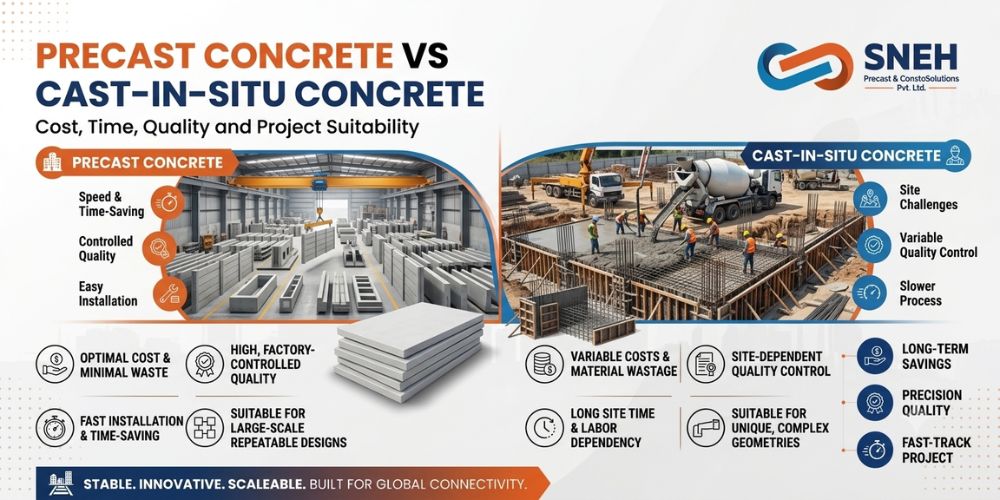
Precast Concrete vs Cast-in-Situ Concrete: Cost, Time, Quality and Project Suitability
Choosing between precast concrete and cast-in-situ concrete affects project cost, construction time, labour requirements, quality control and site execution. Both methods are used across infrastructure, industrial and building projects, but their suitability depends on project scale, design requirements, site conditions and construction schedules.
Understanding the difference between precast vs cast-in-situ concrete can help project owners, contractors, architects and engineers select the appropriate construction method.
What Is the Difference Between Precast and Cast-in-Situ Concrete?
Precast concrete is manufactured in a controlled production environment before being transported to the construction site. Components can include beams, columns, slabs, walls, drainage components and other structural or infrastructure elements.
Cast-in-situ concrete, also called cast-in-place concrete, is produced and placed directly at the construction site. Reinforcement, formwork, concrete placement and curing are generally completed on site.
The main difference is therefore the location of production and installation. Precast construction separates manufacturing from site construction, while cast-in-situ construction carries out most concrete work at the project location.
Precast vs Cast-in-Situ: Cost Comparison
The precast vs cast-in-situ cost comparison should consider the complete project rather than only the price of concrete.
For precast construction, the cost calculation can include manufacturing, moulds, transportation, lifting equipment, erection, connections and finishing. Cast-in-situ construction may involve costs for site formwork, reinforcement fixing, labour, concrete placement, curing and dismantling of formwork.
For repetitive or large-scale projects, reusable moulds and controlled production can improve material and labour efficiency. However, transportation distance, crane requirements and project access can influence the economics of precast components.
Therefore, precast concrete cost in India cannot be assessed using a single rate. Project size, component design, transportation distance, production requirements and installation conditions all need to be considered — get a tailored quote based on your specific project.
Which Construction Method Is Faster?
Construction time is one of the main reasons precast systems are considered for projects with demanding schedules.
With precast construction, components can be manufactured while other site activities are taking place. Once the required site conditions are ready, components can be transported and installed using appropriate lifting equipment. Our step-by-step box culvert installation guide illustrates how this parallel-production advantage plays out on an actual project.
Cast-in-situ construction generally requires several sequential activities, including reinforcement placement, formwork, concrete placement, curing and formwork removal.
This means precast construction time can be reduced in suitable projects, particularly where components are repetitive and production can be planned in parallel with site preparation.
However, transportation, lifting, connections and site access must be included when comparing the complete construction timeline.
Quality Control: Precast vs Cast-in-Situ
Quality control is another important consideration when comparing precast vs cast-in-situ quality.
Precast components are generally produced under controlled conditions where processes such as batching, mould preparation, reinforcement placement, concrete placement and curing can be monitored systematically.
Cast-in-situ concrete can also achieve the required quality when appropriate specifications, workmanship, testing and curing practices are followed. However, site conditions can introduce variables such as weather, access, material handling and labour availability. Poor site execution is often where problems creep in — see our breakdown of common AAC block wall construction mistakes for an example of how workmanship gaps affect outcomes regardless of method.
Neither method automatically guarantees better concrete. Concrete strength, reinforcement detailing, curing, dimensional accuracy, connections and quality inspection all influence final performance.
Labour and Site Productivity
The labour requirements of the two methods are different.
Cast-in-situ construction requires site teams for reinforcement fixing, formwork, concrete placement, finishing and curing. Precast construction shifts a significant portion of these activities to the production facility.
At the site, the focus moves toward transportation, positioning, lifting, alignment and connections.
Therefore, precast construction labour cost should be assessed as part of the entire production and installation process rather than by comparing only the number of workers at the construction site.
Design Flexibility and Project Suitability
Design flexibility is an important factor in the decision.
Cast-in-situ concrete can be suitable for structures with irregular geometries, frequent design changes or conditions where manufacturing and transporting individual components would be difficult.
Precast concrete can be particularly suitable for projects involving repetitive components, controlled dimensions and planned installation sequences.
Applications may include highway infrastructure, drainage systems, industrial and commercial developments and other infrastructure projects where repeatable components can support planned production and installation.
Site access is also important. Large precast elements may require suitable roads, storage areas, cranes and lifting plans.
Which Method Produces Less Construction Waste?
Precast production can provide greater control over material use because components are manufactured according to defined dimensions and production requirements. Reusable moulds can also support repeated production.
Cast-in-situ construction can generate waste from temporary formwork, cutting, concrete handling and other site activities depending on project management practices.
The actual environmental performance depends on factors such as material efficiency, transportation distance, production processes, component design and project execution.
When Should You Choose Precast Concrete?
When to use precast concrete depends on the project rather than a universal rule.
Precast may be worth evaluating when a project has:
- Repetitive components
- Large quantities of similar elements
- Tight construction schedules
- Controlled production requirements
- Suitable transportation access
- Crane and erection facilities
- Planned construction sequences
- Infrastructure or industrial applications
Cast-in-situ concrete may remain suitable where project geometry is highly variable, site access limits component transportation or frequent design modifications are expected.
Precast vs Cast-in-Situ: Which Is Better?
There is no single answer to "Which is better, precast or cast-in-situ concrete?"
The right method depends on project cost, construction time, quality requirements, design complexity, labour, transportation, site access and installation requirements.
For large and repetitive infrastructure projects, precast concrete can provide an alternative to extensive site-based concrete work. For projects requiring greater on-site flexibility, cast-in-situ concrete may remain appropriate.
For contractors and project owners, the better approach is to compare the total project cost and execution requirements rather than selecting a construction method based only on material price.